This article is brought to you be Eurobodalla Shire Council.
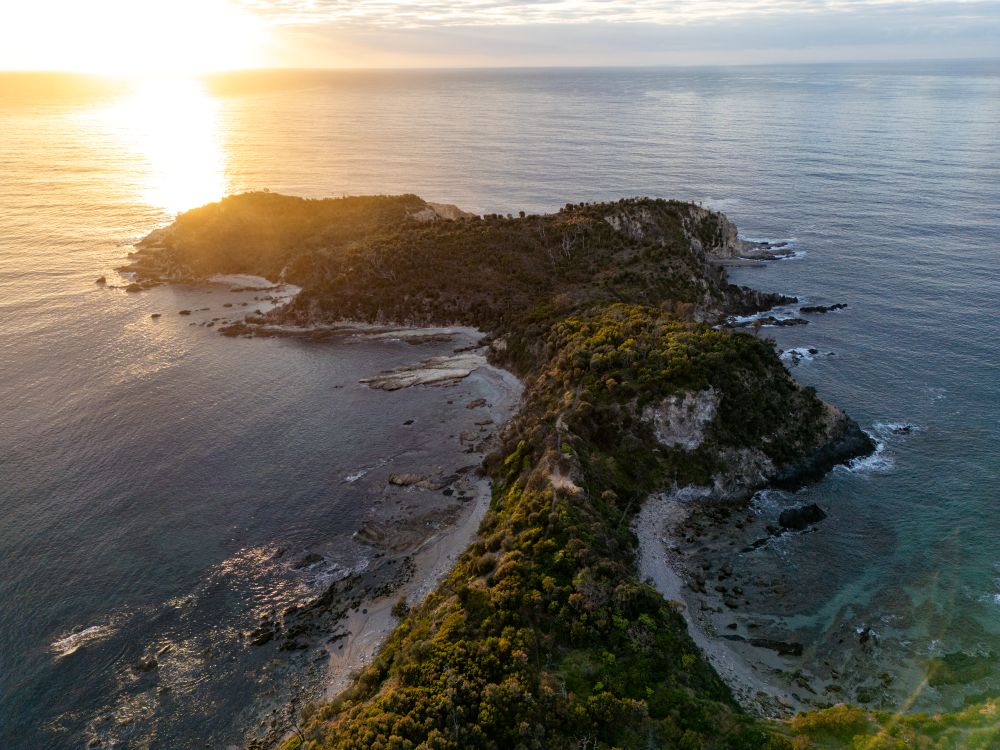
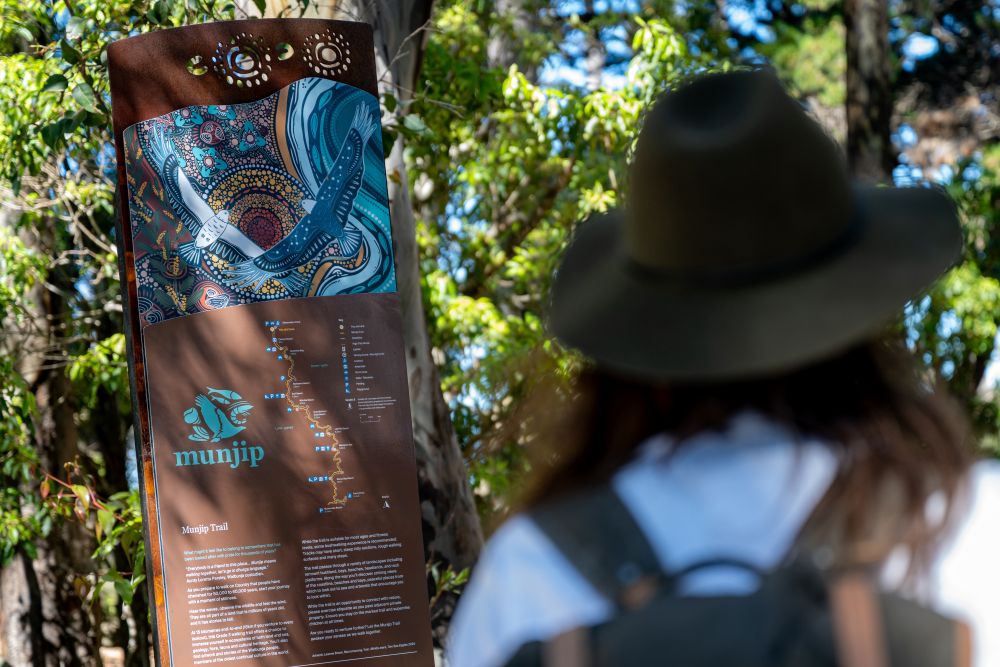
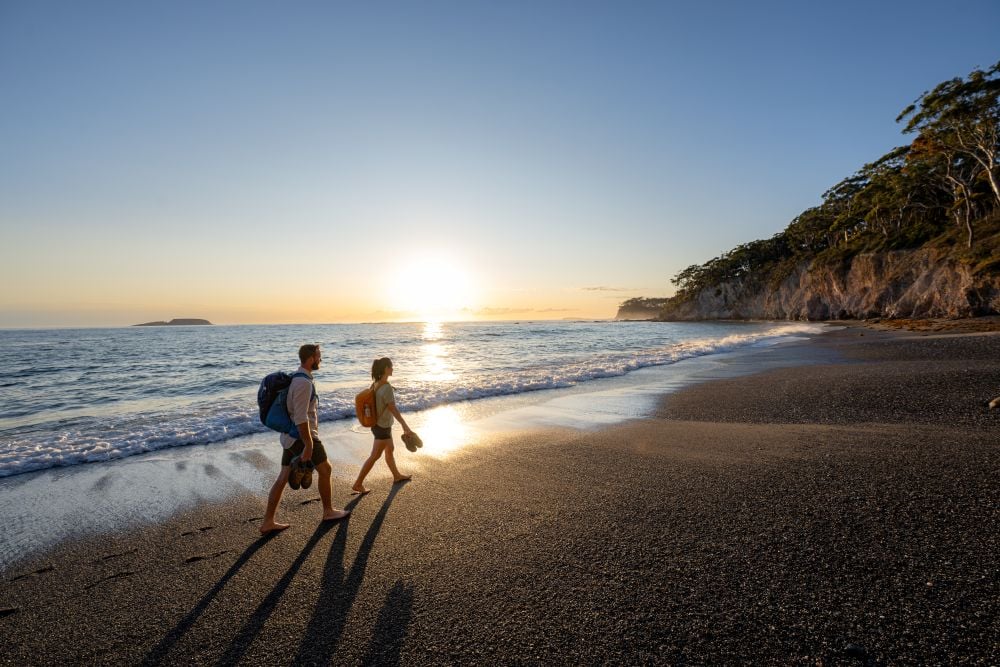
The Munjip Trail is a 15–18km coastal walk linking beaches, headlands and townships from Batehaven to McKenzies Beach, just south of Batemans Bay. Rated Grade 3, it suits day walkers, runners and families. The route passes surf breaks, lookouts and reserves, with opportunities to swim, fish or snorkel. Interpretive signs, artworks and audio guides share Walbunja Yuin Stories developed with local Elders.
“Go past the post office,” Aunty Loretta said. “Then follow your nose. You’ll know when you get here.” At least, that’s what I thought she said.
Driving north from Batemans Bay, I scanned the roadside for a rusting Australia Post sign, but there was nothing – just tall gums, the shimmer of blackbutt leaves, and the occasional dirt track vanishing into the bush. When I finally turned off the highway onto a dusty gravel road that vanished into a wall of old eucalypts, I spotted them – a crooked row of letterboxes hand-painted, dented and quietly surrendering to rust. “Ahh… the post office,” I laughed, realising my mistake.
Ten minutes later, I reached gateposts decorated with Aboriginal art. This was most definitely the place.
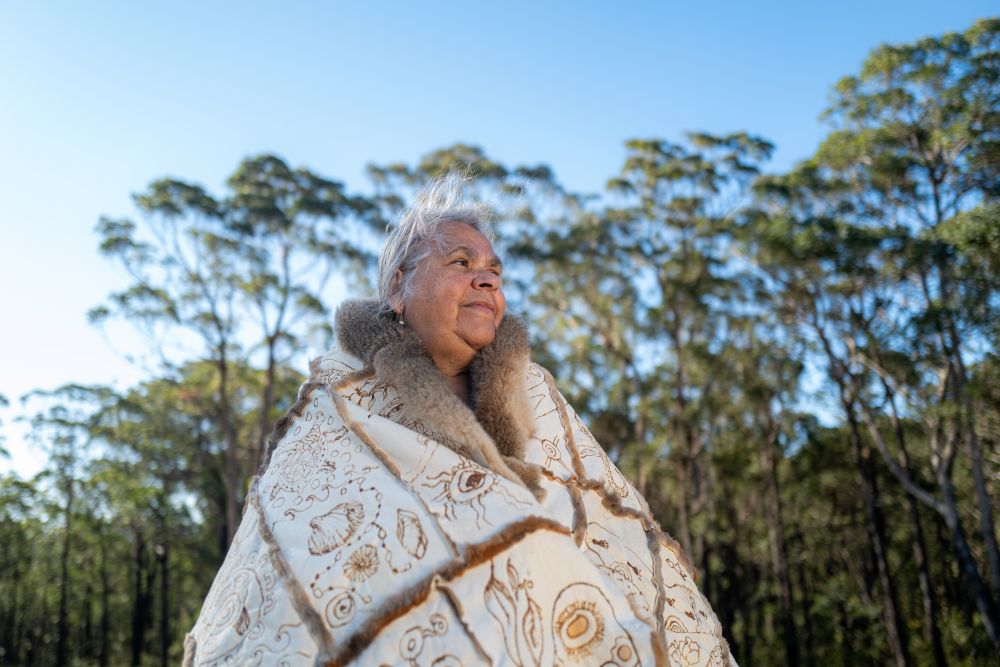
I parked beneath a towering spotted gum. The air was still and smelled faintly of eucalyptus – and maybe woodsmoke? Before I could take another breath, however, a woman stepped from the patio; grey hair as wild as the country around her lifted with the breeze, her eyes bright and welcoming. She smiled as if I were a long-time friend.
“There are no fences here,” she said. “The animals come and go as they please. We use cultural burning to help keep the bush healthy.” Kookaburras called from the canopy, and the house sat cradled in bushland that looked carefully loved rather than tamed.
I had just walked the Munjip Trail. A 15–18 kilometre coastal route linking beaches, headlands and coves from Batehaven, just south of Batemans Bay, to McKenzies Beach. I loved it, but I wanted to better understand the Country beneath my boots, the deeper meaning of the trail and how best to walk it.
For Aunty Loretta, Munjip is more than scenery. It’s one path within a much older journey; a saltwater songline of ancestral tracks carrying the continuity of cultural lore across Walbunja Country. She explained that lore is not written in books but sung into the landscape itself. Walking Munjip, she said, is a way of moving through those stories and feeling the knowledge of Country beneath your feet.
As we sat together, she spoke with the calm certainty of someone whose roots run deep in this place. You could hear the affection in her voice when she described the stillness; to “feel the ambience of it… know the ancestors are here,” she said, and I understood what she meant.
I told her of our walk along the trail — the friendly swamp wallaby at Pretty Point, an echidna ambling through the undergrowth, and the bush alive with wildflowers. It had felt as though the landscape itself was putting on a show. I told her about the four sea eagles (Mirida in local language) that flew in formation over Pretty Point as we walked, something I had never seen before, and she smiled.
“They were welcoming you,” she said. “We see them as a welcoming as well, and a good omen for being on Country.” Those birds, she explained, weren’t a coincidence; they were kin, a totem.

For Loretta, the Munjip Trail is far more than a walking route.
“Our ancestors used to walk all along there, because it’s abundant,” she said. “You’re walking on the grounds the ancestors have walked.”
She paused for a moment, looking toward the trees. It was clear that, for her, each step along the trail was an act of recognition, a quiet conversation between people and place.
She spoke of the ochres that still stain the cliffs near the trailhead.
“They were used to paint ourselves during ceremony,” she said.
Further inland, the great mountains of the Yuin Nation rise from the coast.
“When you look at Didthul… you’ve got Kongari… then you’ve got Gulaga, and then Biamanga… They all align through our songlines.”
Listening to her, I began to appreciate even more the rhythm of the route.
“We’re coastal people, saltwater people; our foods came from the ocean,” she said. “When you walk along it, you’re listening to the water, you’re listening to the sky, you’re listening to the wind… the waves are generated by wind, and that brings fish in from the open sea.”
The way she spoke drew unseen threads between the natural world and a deep connection to Country, weaving them into something more tangible.
“We’re coastal people, saltwater people; our foods came from the ocean,” she said. “When you walk along it, you’re listening to the water, you’re listening to the sky, you’re listening to the wind… the waves are generated by wind, and that brings fish in from the open sea.”
The way she spoke drew unseen threads between the natural world and a deep connection to Country, weaving them into something more tangible.
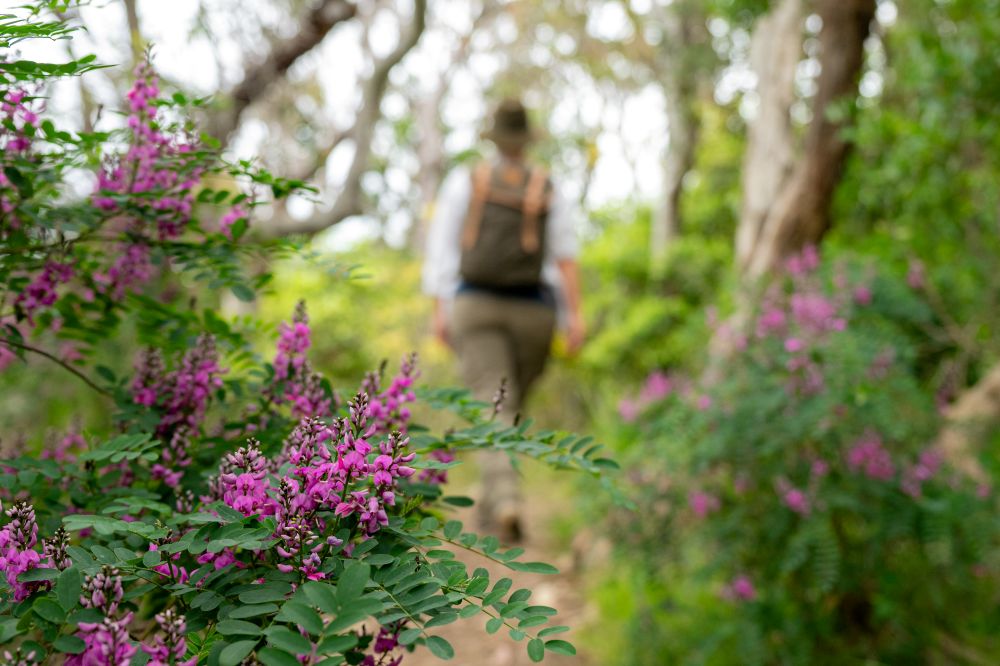
“That purple vine you’d have seen,” she said, “that is sarsaparilla. When it’s dried out, you can make tea out of it.
“There are plants there,” she continued. “You can photograph it, sure, but then you might say, ‘I need to find out whether it’s edible.’ And how do you do that? You can ask a local custodian.”
It was as though every colour, scent and sound ‘on Country’ carried meaning, if you slowed down long enough to ask.
“If people take the time to start at the beginning and walk, you’re walking on Country,” she said. “When you walk in the footsteps of the ancestors… they’re allowing you to see things that are important to the landscape — in the form of a plant, the lizard, the blue-tongue lizard, who loves being around the rocks.”
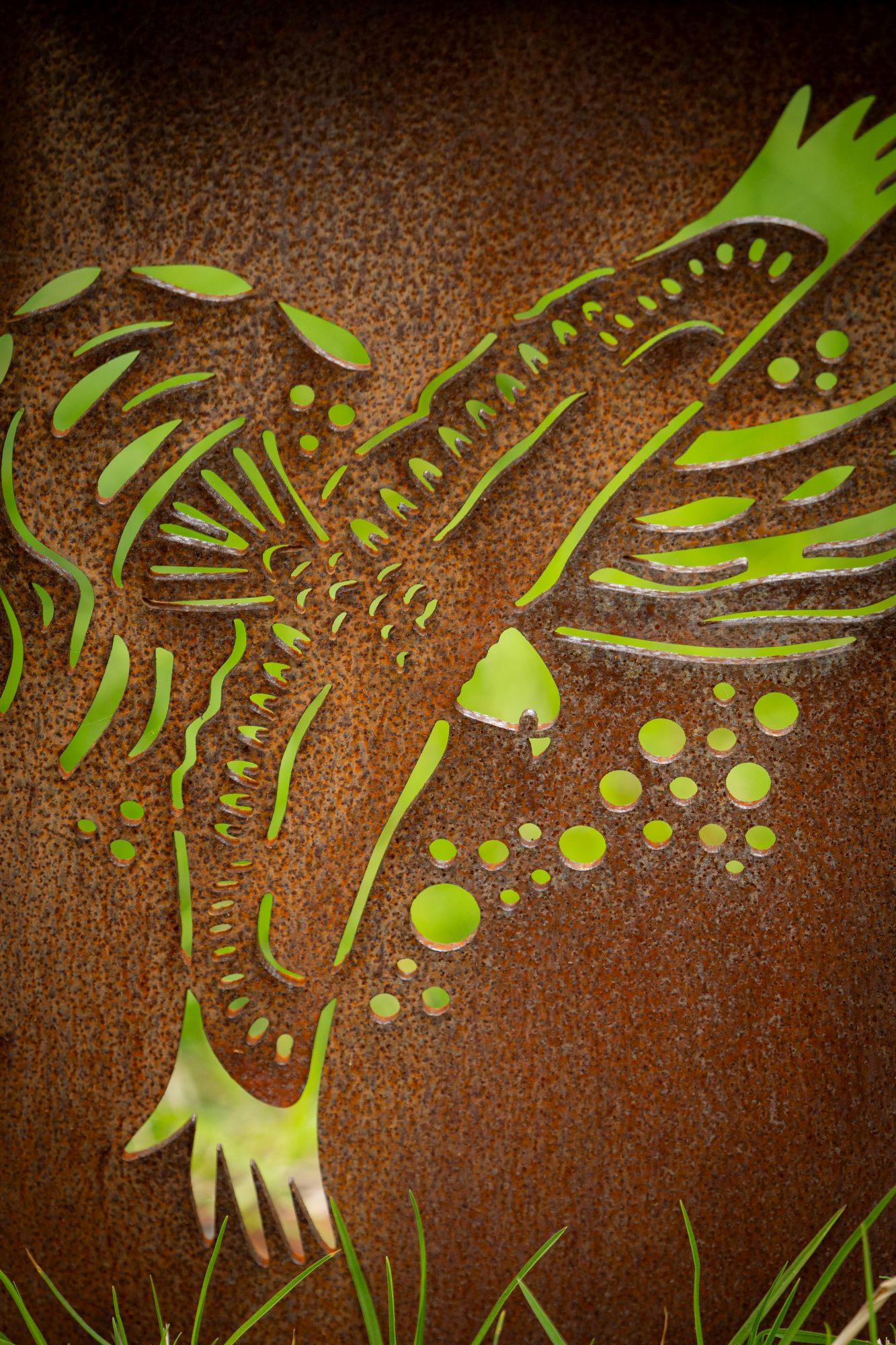
Along the trail, contemporary artworks and interpretive installations give voice to these stories.
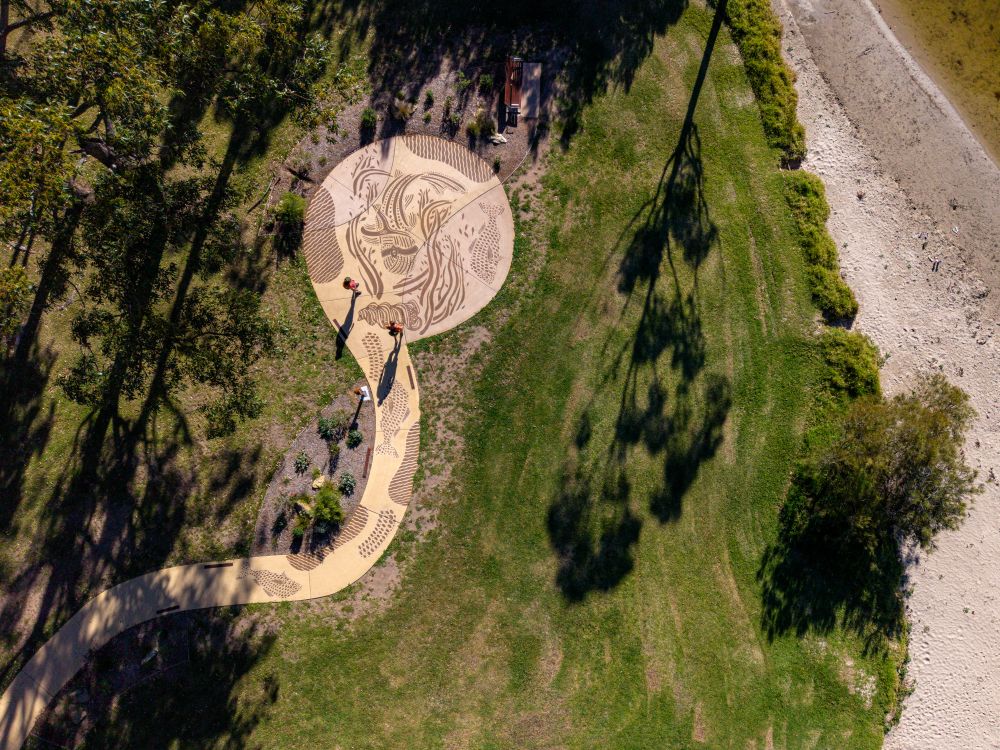
The trail’s interpretive art reflects that continuity. Featured artworks include Leanne Brook’s Mirida-wara (Two Sea Eagles) at the trailhead; Natalie Bateman’s yarning-circle mural Wimbie Beach; Bronwen Smith and Gavin Chatfield’s Celebrating Community mural at Caseys Beach; Nigel Stewart’s Gadu – Umbarra – Gadu Dreaming mural; and Timeika Reena Slockee’s laser-cut privacy screen installation Gadu Gurrad – Coastline Connections. Each piece bridges past and present, echoing Aunty Loretta’s belief that “songlines are not myth, but movement”.
The Munjip’s name itself carries a story.
“It’s pronounced Munyip,” Loretta explained when I asked. She smiled as I failed to mimic the nasal tone.
“Aboriginal people have the nasal phonetics to say it. If you were to learn that word, you’d have to practise it, because you don’t have that nasal phonetic. That’s the beauty of our language.”
We return to caring for Country, and she reminded me that it is not symbolic; it’s lived.
“Aboriginal people only take what they need,” she said. “You need to leave things behind, for the next generation, for the next feed.”
Her words hung in the air like smoke from one of her slow, controlled cultural burns; simple, practical, maybe even profound, but words we can all learn from.
Later, outside her home, Loretta unfolded a possum-skin cloak stitched and burned with hot irons and painted with ochres, each panel holding a story of ancestry.
“My totem is the black duck… You have to protect that black duck… You don’t own it, you look after it.”
Concentric circles marked gathering places, while the etched tracks of a white possum from Mystery Bay threaded between panels, symbolising movement across Country.
“He’s all around us,” Aunty Loretta said. “He walks on Country all the time, and then he’s walking to many places.”
Songlines, she explained, are not myth but movement.
“Our people travelled. They stopped at places that were culturally significant for dance, for fresh water, for the ocean and its food. They traded.”
These routes of story and sustenance, she said, are the connective tissue of belonging.
“You return to your birthplace, your Country. That gives you apical ancestry to belong to Country.”
I pondered again the sea eagles of Pretty Point and the feeling that the land itself had been watching. Aunty Loretta smiled, reading my thoughts as I quietly voiced them.
“That’s because they welcomed you,” she said. “Everything was there, saying: ‘Look at what we’ve got.’”
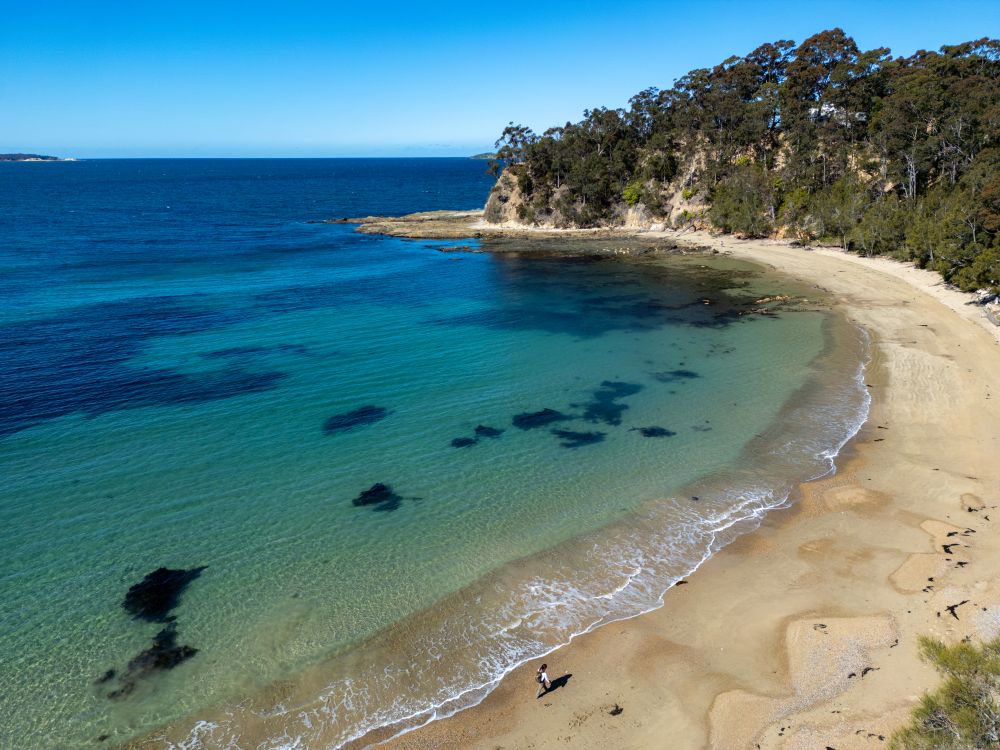
My brief visit with Aunty Loretta had turned into an afternoon of understanding Country. I’d popped in for a quick chat, but the sun was sinking when I finally waved goodbye. However, I could have stayed longer. Not only was I better informed and better connected, but it all made so much sense. Everything from the post office to whales cruising slowly south, returning from their thousands-of-kilometres journey to calve up north.
Maybe we all need to take a page out of Aunty Loretta’s and the whale’s book and meander south, along the Munjip Trail.
It’s certainly not all connection to Country. There are cars, shops, beachgoers and modern mansions along the way, but those moments only heighten what lies between – the bursts of wildflowers, the sight of soaring sea eagles above and jacky dragons sunning alongside the trail. In early spring, the breeze carries the faint sweetness of wattle through the gums, a native perfume drifting between bush and backyard. Here, we walk the songlines of ancient Australia in modern times.
I’m reminded of some of Loretta’s last words: “You’ve got to imagine what it looked like hundreds of years ago, before the roads, before the houses,” she said. “The old people walked through there; they knew every plant, every sound, every smell. Everything meant something.”
Amazingly, we don’t need to venture into the unknown to learn all this; it’s right on our doorstep, just metres from local caravan parks or boutique luxury accommodation. And when you return from the trail, the simple joys of the region feel somehow even richer: a dozen oysters at Wray Street, a gin at Foxdog, a beer at Broulee Brewhouse. Maybe a classy eco cabin at The Bower at Broulee is your style (I admit I treated myself), or if a peaceful night under canvas, among the gums, is more your cup of sarsaparilla tea, then camping might be the go for you.
Whether you end your walk with bubbles or bare feet, you’ll carry the same rhythm home: that soft reminder to tread lightly, listen deeply, and walk together.
Fact file
Where We Stayed (trip supporters)
NRMA Broulee Holiday Park: We stayed in a glamping tent tucked behind the dunes. Options range from basic tent sites to large family cabins.
Hipcamp: Book direct with local hosts. Sites range from $30 tent pitches to luxe nature stays.
The Bower at Broulee: Luxury eco and wellness retreat. Private cabins, spas and wildlife at your deck.
Do More
Whales: Batemans Bay Wild offers two-hour whale-watching cruises from Batemans Bay during the annual whale migration which peaks August to November; weekends (and weekdays in school holidays and busy periods), weather dependent; book ahead.
Surf: Broulee (beginner/intermediate/advanced); Surf Beach (beginners).
Snorkel: Hidden coves (Sunshine Cove, Guerilla Bay, Orangestone Cove).
Kayak: The Clyde estuary and coast, Broulee Island, Tomaga River.
Mountain Bike: Mogo and Narooma trails.
Food and Drink (our picks)
Crumb Cafe (Batehaven): Pre/post-trail coffee.
Three66 Espresso Bar (Mosquito Bay): Mid-trail coffee.
The Mossy Cafe (Mossy Point): Pre/post-trail coffee.
Killibinbin Cafe (Broulee): Low-key, loved by locals.
Broulee Brewhouse (Broulee): Post-hike crafties.
Foxdog Distillery (Mogo): Gin tastings, cocktails and wood-fired pizza.
The Oyster Shed on Wray (Batemans Bay): Freshly shucked oysters on the banks of the Clyde River.
EUROBODALLA
For more info on this spectacular region see Eurobodalla.