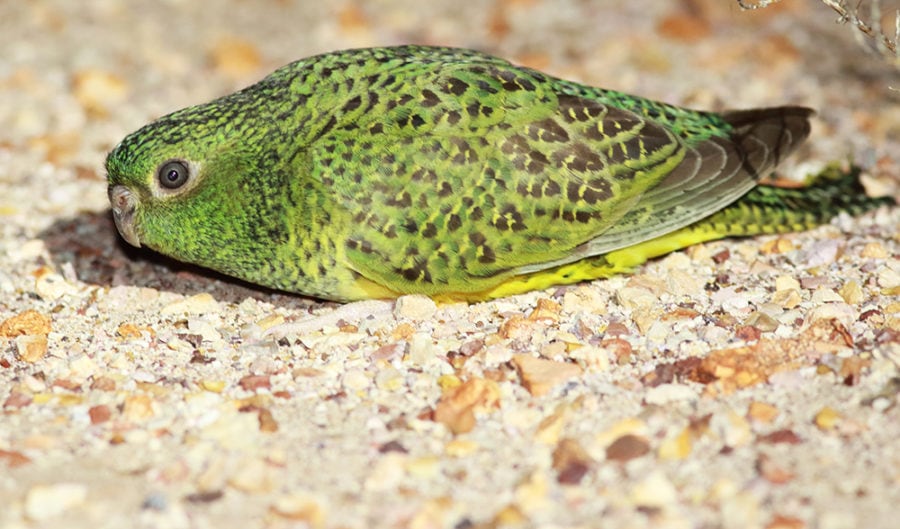
The enigma of the night parrot
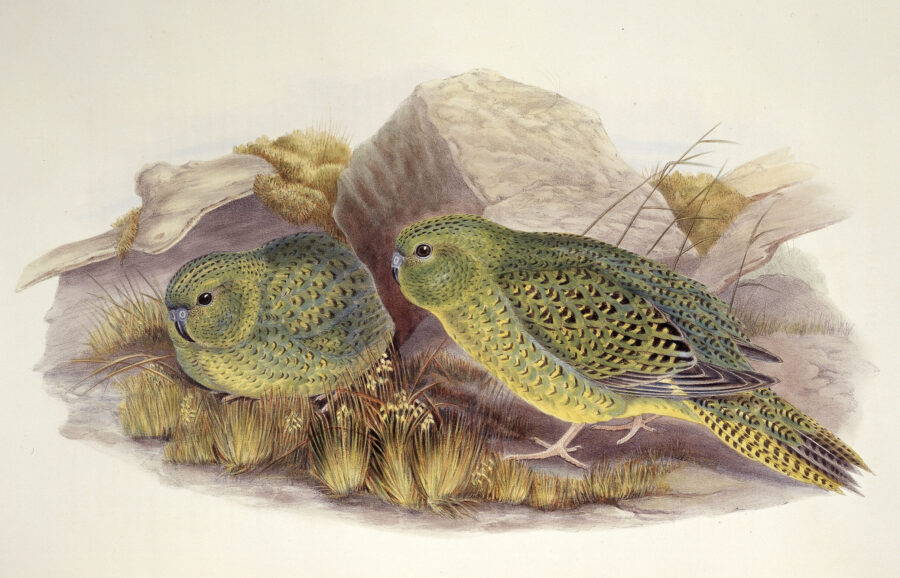
For ecologist Dr Nick Leseberg of Bush Heritage, who’s devoted years to studying this elusive bird, its biology alone makes it remarkable. “The obvious unusual trait is the fact that not only is it nocturnal, but it’s a parrot,” he says. “It’s one of only two nocturnal parrots in the world. We’re familiar with owls and nightjars, but it’s extraordinary for a species from a family that isn’t specialised for nocturnality to make that shift.”
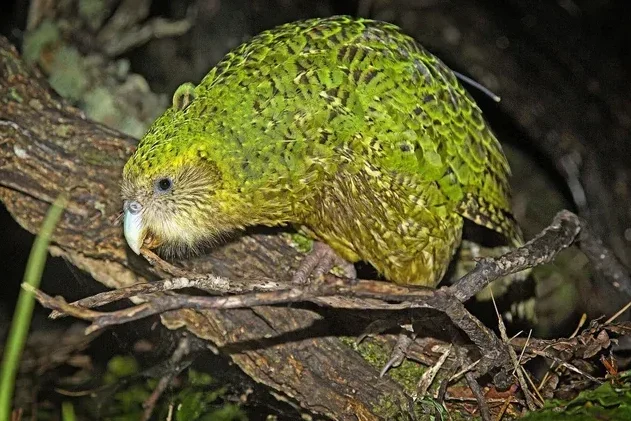
The only other parrot to share this lifestyle is New Zealand’s kakapo. “Interestingly, they look quite similar, which is a case of convergent evolution,” says Nick. “Species with similar life histories can end up resembling one another.”
For Maiawali Traditional Custodian Aunty Judith Harrison, the bird is not just a scientific curiosity but a deeply cultural presence. “The night parrot is a sacred bird. It’s part of our Country, part of our stories. When it was found again, I felt so proud and happy. It’s like a little piece of our spirit has come back.”
Its nocturnal lifestyle makes the bird notoriously difficult to study. “With diurnal birds, you can watch them, band them, take notes on their behaviour. With night parrots, you can’t do any of that. It’s like trying to research something in thick fog. You only ever see the outlines,” Nick says.
Instead, researchers rely on sound. Night parrots are surprisingly vocal, especially after rain, and autonomous recorders placed in the field allow scientists to track their movements and their breeding activity. “Your best chance of studying them is with sound. Recent research suggests we can probably distinguish individual birds by their calls, giving us a way to try to estimate population size and movement,” Nick explains.
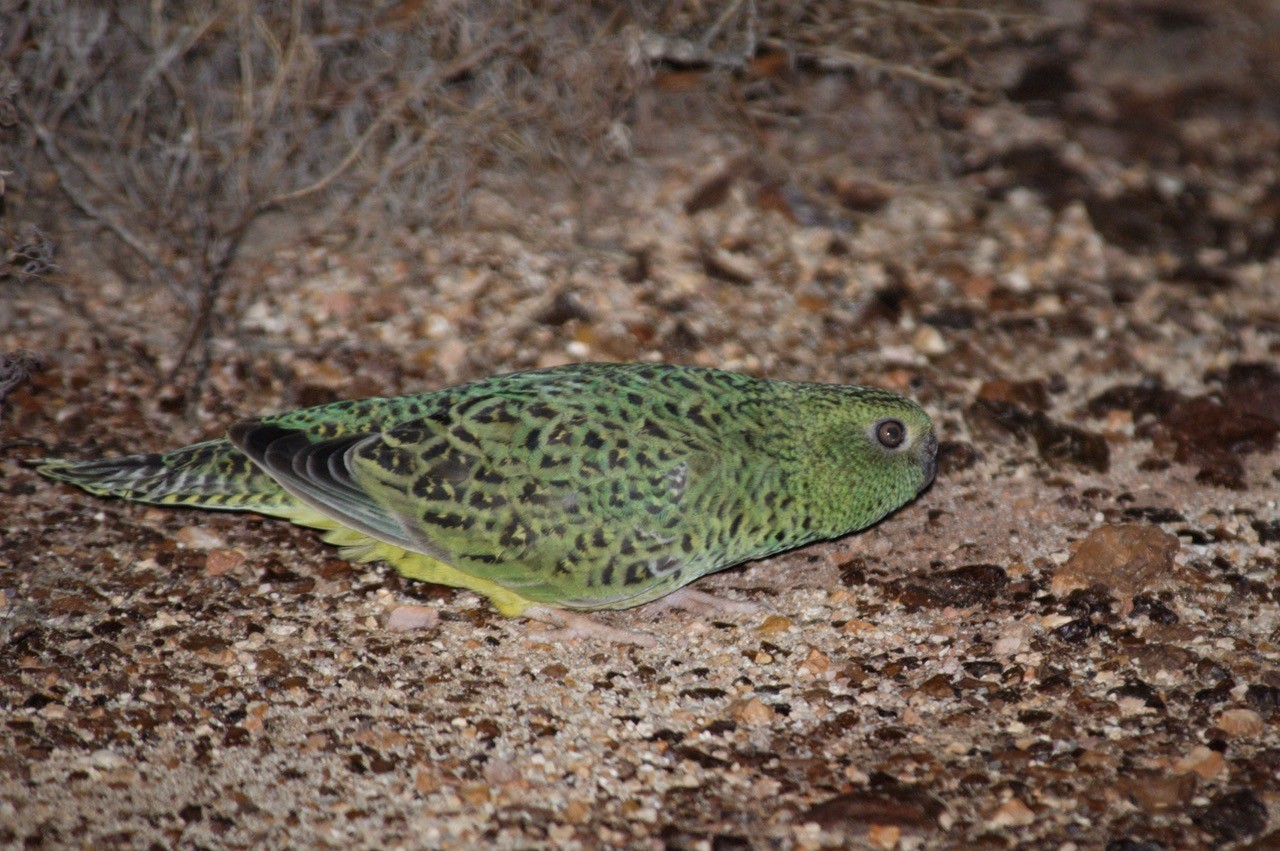
For serious birdwatchers, for whom the night parrot is a holy grail, that presents a philosophical shift. “With night parrots you don’t see the bird, you only hear it. That’s how you experience it,” says Nick. To seek a visual encounter would mean disturbing the bird in its fragile daytime refuge.
For Aunty Judith, listening is critical to her relationship with the land. “Our people listen to Country. We listen to the wind, to the birds, to the animals. So, it makes sense to me that you know the night parrot by its sound. That’s how we connect with it. Quietly, and with respect,” she says.
Despite their secrecy, night parrots are powerful travellers. GPS tagging has shown them covering up to 40km in a single night. Yet their night vision is compromised. “It’s been described to me like a camera on high ISO (film speed). You can see in low light, but the image is grainy. We think that’s why they sometimes collide with fences,” Nick says.
Parallels with mammals
Why would a parrot evolve to live a nocturnal life? The answer lies in the ecology of arid Australia. “If you think about small mammals in central Australia, almost all of them are nocturnal,” says Nick. “The night parrot is much like a small mammal. It lives on the ground, eats seeds and fruits, and comes out when it’s cooler and safer. Nocturnality was simply the best way to survive.”
For Aunty Judith, this resilience reflects the Country itself. “Our land has suffered, but it survives. The night parrot shows us that even small, hidden things can endure if they find the right way.”

At Bush Heritage’s Pullen Pullen Reserve, feral cats pose the greatest risk. “Foxes are rare in that part of the world, so cats are the main danger. We control them through trapping and shooting, but it’s expensive and constant. Every cat you remove, another eventually comes in,” says Nick.
Despite this, a decade of active conservation management at Pullen Pullen since the parrots’ rediscovery appears to have reduced pressure on the birds. “The population seems to be increasing, though with night parrots it’s always hard to be sure,” says Nick.
Restoring connections
For Traditional Custodians the bird provides a bridge back to Country.
In the deserts of Western Australia, where other populations of night parrot have also survived, some elders still recall the parrot from their youth and call it by its old Indigenous names. In Queensland, the memory was disrupted by disconnection from the land, but the rediscovery has become a vehicle with which to reconnect.
“The night parrot has given me a way back to my Country,” says Aunty Judith of the Diamantina region of south-western Queensland where she grew up and within which the reserve lies. “When I go out there and know it’s living among the spinifex, I feel the old stories come alive again. It’s not just about saving a bird; it’s about healing that bond.”

Story of hope
Ultimately, the night parrot’s survival offers inspiration. “If you look on the negative side, it’s a long story of misery and failure,” says Nick. “But the night parrot gives us hope. It was out there all along, and now we have the chance to recover it. It’s going to be hard and expensive, but it shows us that sometimes we can find what we feared was lost.”
For Aunty Judith, the bird is both symbol and companion. “When I hear its call, I know my Country is still alive. That makes me happy. It means there is still something here to look after, for our children and grandchildren.”
How you can help
If you would like to play your part in the recovery of the uniquely amazing night parrot, you can donate to our Australia’s Most Endangered fundraiser between November and December.
All funds raised will go to Bush Heritage to help Aunty Judith and Dr Nick Leseberg in their inspirational work to bring the night parrot back from the edge of darkness and into the light.
Help Save the night parrot – DONATE NOW — Australian Geographic
Parroting facts
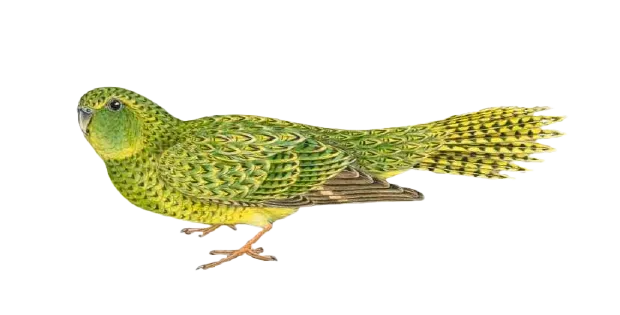
- Elusive and nocturnal: One of the world’s most mysterious birds, the night parrot (Pezoporus occidentalis) is ground-dwelling, secretive and active only after dark in arid and semi-arid spinifex grasslands and floodplains.
- Rediscovery after a century: Long thought extinct, it was dramatically rediscovered in western Queensland in 2013, the first confirmed living sighting in more than 100 years.
- Appearance and size: Stocky, mottled green, yellow and black plumage for camouflage; long wings; short tail. About 22–25cm long, weighing 80–100g.
- Life cycle and breeding: Still poorly understood. Known to nest in tunnels beneath spinifex clumps, laying 2–5 eggs. Breeding is linked to conditions, especially flooding, which results in resource booms, when seeds are abundant. Longevity remains unknown, but parrots of similar size can live 10–15 years in the wild.
- Feeding behaviour: Diet is mainly seeds from grasses and herbs; forages at night on the ground. Known to visit water, including farm dams, rockholes, or ephemeral waterholes after rains.
- Flight and calls: Sometimes seen flying low around roosting and foraging areas, but capable of
travelling larger distances, and is probably a strong flier. Calls include soft whistles and high-pitched notes, often heard only briefly at night. - Cultural significance: It appears in Dreaming stories as a shy, sacred night creature, carrying teachings of respect, patience, and humility. Elders celebrated its rediscovery as confirmation that ancient knowledge endures.