The curse of ugly
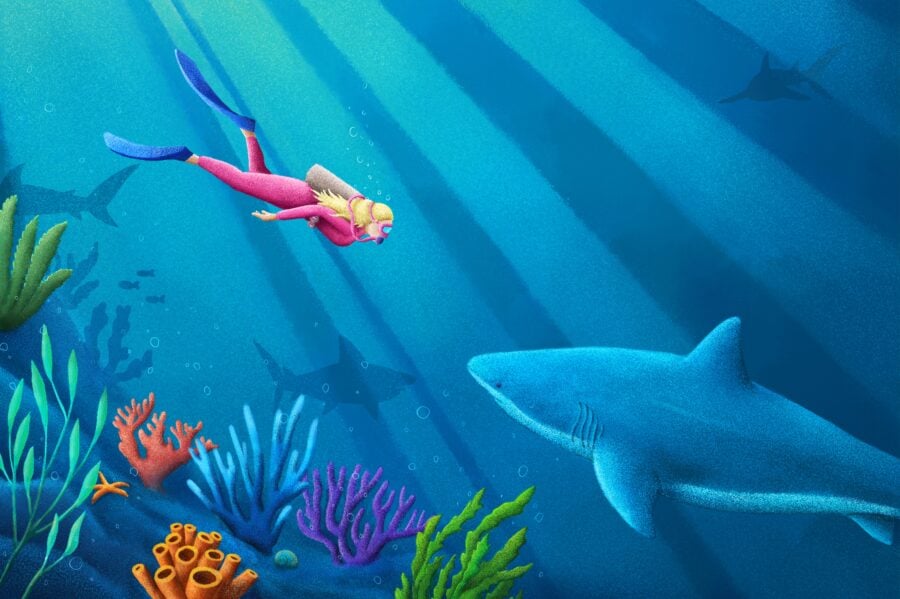
This extract comes from Natalie Kyriacou’s debut book Nature’s Last Dance: Tales of Wonder in an Age of Extinction.
Any animal that incites fear, revulsion, apathy or boredom is susceptible to being overlooked in wildlife conservation. Perhaps no creature has been more maligned than one that has existed for millions of years, predating even the dinosaurs.
“They are darlings,” says conservationist Valerie Taylor. “They’re wonderful to dive with, a big smile full of teeth.” She is, of course, talking about sharks. The grey nurse shark, according to Valerie, is “gentle, polite, and not at all dangerous”. You need to be careful around the great white, though. “The great white investigates the unusual. And they don’t have hands, so they use their teeth,” she says matter-of-factly.
Valerie is a protector of sharks, a marine pioneer, a filmmaker and an icon of the ocean. She has swum into the belly of a whale carcass with a school of oceanic whitetip sharks during a feeding frenzy. She has been a pack member to great whites. She is a fearless campaigner for ocean protection. She has had museum exhibitions in her honour, marine parks established in her name and documentaries that came to life through the work of her and her late husband, Ron. They worked with Steven Spielberg, and their filmmaking both inspired and featured in the 1975 blockbuster movie Jaws. Valerie is the reason the grey nurse shark is a protected species. She has been bitten and bumped and nudged and caressed by sharks. And she has loved every minute of it. “I have had a great life,” she says.
Valerie dived and documented the ocean and its prehistoric creatures for more than 65 years, most of them with Ron, even as arthritis set in – “thousands and thousands of dives,” she says. She began her underwater career as a spearfisher, hunting in the same seas she would later protect – often the only woman on the boat. Alongside Ron, Valerie evolved from hunter to defender, devoting her life to understanding, documenting and conserving marine life.
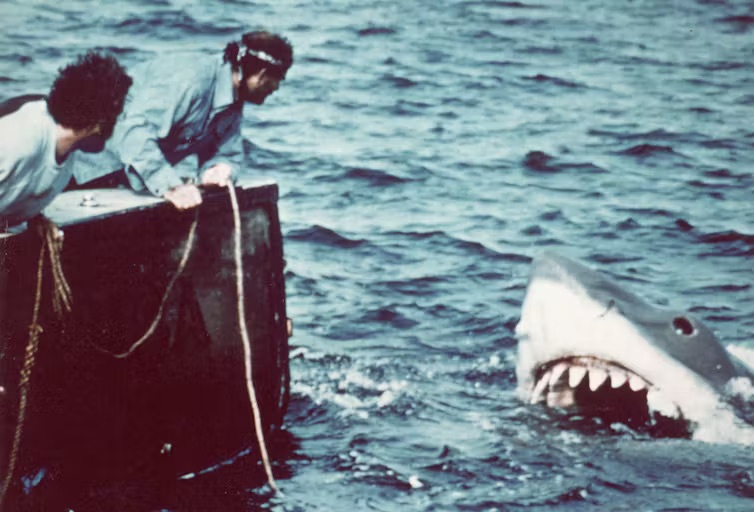
In the 1950s, Valerie and Ron began capturing life beneath the waves, fascinated especially by sharks. Their remarkable underwater footage soon attracted Hollywood’s attention. Steven Spielberg, looking for authentic footage of great white sharks for the production of Jaws, hired Valerie and Ron to film in South Australia. Spielberg was so captivated by their footage that he had the script altered to include more of it, ultimately creating one of Jaws’ most suspenseful scenes. Valerie and Ron, to their delight, found themselves working on what was to become the highest-grossing movie of its time. Following the film’s release, the couple went on a tour funded by Universal Studios to educate the public about sharks, aiming to dismantle harmful myths that were circulating in the movie’s wake.
“We told the public not to be afraid,” Valerie says. “Jaws was a mechanical shark and a fictitious story. People didn’t have to stay away from the beaches. People were already fearful of sharks. The media had a lot to do with it. The saying at the time was, ‘The only good shark is a dead one.’ Ron used to say, ‘You don’t go to New York and expect to see King Kong on the Empire State Building. Neither should you go into the water expecting to see Jaws.’”
Shark decline
Fear of sharks has fuelled policies and practices that are devastating to shark populations – and, by extension, to the marine ecosystems essential to life on earth. But despite the fact sharks are critical to maintaining ocean health, the global response to sharks has been largely punitive. Fear-fuelled and reactionary initiatives like shark culls, beach netting and so-called ‘shark control’ programs have led to the indiscriminate killing of these prehistoric apex predators, driven largely by deeply ingrained biases and misconceptions and a tendency to project human emotions onto creatures that don’t fit our idea of ‘friendly’.
Each year, around the world, sharks are responsible for an average of 10 deaths. Notably, these incidents typically involve just a handful of specific shark species (out of more than 500), and most are the result of curiosity or a case of mistaken identity, not malice. Statistically, your lifetime risk of dying in a shark attack is astronomically low compared to just about anything else. In fact, you’re far more likely to die by choking on a hot dog or from taking a selfie (259 people died taking selfies between October 2011 and November 2017). For a little perspective, more people die each year from being hit by a flying champagne cork (24 deaths) than from shark attacks. As for the animal kingdom’s true villains, sharks don’t even make the list of the top 10 species most dangerous to humans. Mosquitoes cause 1 million deaths per year. Dogs cause 30,000 deaths per year. Freshwater snails cause 20,000 deaths per year. Even cows kill more people than sharks. But, as Valerie says, “people don’t like the thought of being eaten alive”.
When it comes to sharks, Valerie is emphatic: their behaviour is not personal. “They aren’t here to hurt you!” she says. “They’re bottom feeders. Their mouth is under their head! They’d have to turn upside down to eat you!” To her, the loathing towards sharks is unthinkable and unfounded. “A shark doesn’t come up on the beach and chase you across the road. The decision is yours. You make the choice to go into their domain. You caused it,” she says. “Swim in a swimming pool or a lake or river! Don’t blame the shark.”
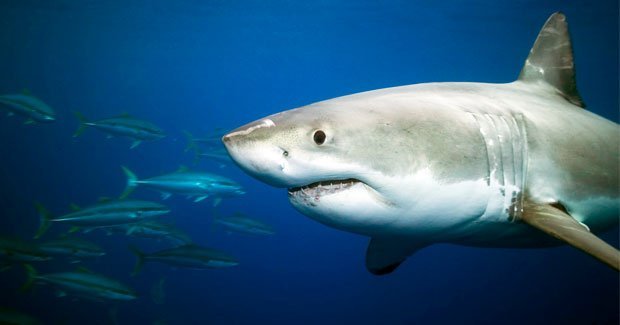
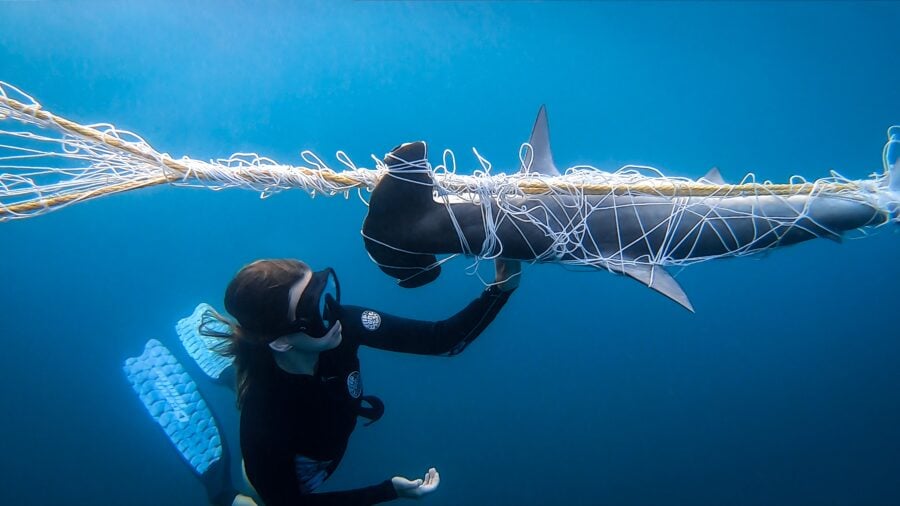
The decline in shark populations is not a small or isolated issue; it’s a systemic crisis. Sharks, which had survived all five mass extinctions, are now spiralling towards complete collapse under humanity’s assault due to a combination of overfishing, bycatch and targeted hunting. For 450 million years, these primordial predators roamed the seas, existing even before the first trees. Yet in a mere half-century, humanity slashed their populations by a staggering 71 per cent. In certain regions, species like hammerheads and great whites have seen populations decline by up to 90 per cent over the past
few decades.
As Valerie says, sharks play a specific and crucial ecological role: as apex predators, they maintain the health of marine environments by preying on the weak. “The great white shark eats large things. Its regular prey is the old, the sick, and the unwary. It keeps the species strong. It’s the job nature put it there to do, and they do it very well,” she says.
Sharks aren’t just the villains of horror movies; they’re intelligent, curious creatures, with memories and instincts as finely tuned as any other animal – if not more so. “They’re not just a piece of swimming meat,” Valerie says, pointedly. “They have a brain, and they have a memory, and they know what’s bad and they know what’s good. They’re just not given their due.”
She reflects with some urgency on the state of the oceans. “Everybody should be interested in the marine world. The marine world dies, we die. There is no two ways about it. All life on the planet comes from the ocean originally. That’s a scientific fact, and we treat this mother of all life with great disrespect,” Valerie says. “And unless we change our destructive ways, we are going to pay the ultimate price.”
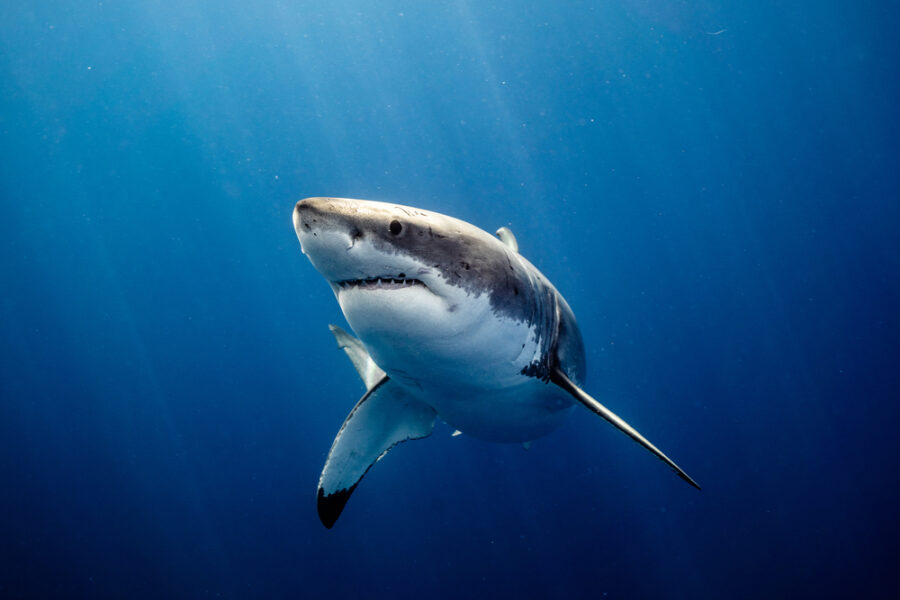
But, as Valerie knows, this fear and bias towards sharks isn’t insurmountable. In the 1970s, she says, the grey nurse shark was inaccurately branded as a killer: “For some reason, media, who love to be dramatic, said grey nurse sharks were attacking people.” This was completely false, she says. In 1984, Valerie made history when she campaigned successfully for the grey nurse shark to become the world’s first protected shark species. Today, she says, “They’re big money makers; tourists come from all over the world to see our beautiful grey nurse.” Not to mention, they’re “gentle darlings”.
Valerie had her final dive in November 2023. She says her arthritis has gotten too bad. But her conservation efforts have left a lasting legacy, which she continues to nurture today. The area where she and Ron filmed their Jaws sequences is now a marine park named in their honour. The park is an internationally significant site for the protection of great white sharks.
She has had the most incredible life, she says: “It has been the greatest adventure.”
“By the way,” she adds. “If you ever got to get bitten by a shark, make sure you are working for Hollywood, okay? They have the best plastic surgeons.”
And, as she reminds people, a shark bite is never personal – they’re just curious.