Located near the southern end of the 70km-long Gold Coast seaside strip – famed the world over for its rideable waves – is a surf break called Currumbin Alley, where beachside memories are created by the bucketful.
The Alley is at the mouth of the estuary where the picturesque Currumbin Creek cuts through Currumbin Beach to enter the Coral Sea. The creek reaches here from 24km to the north-west in the Gold Coast hinterland, where it begins life among the ancient temperate rainforests of Springbrook National Park. Springbrook is part of the Gondwana Rainforests of Australia World Heritage Area, one of Queensland’s five World Heritage properties, and its natural beauty and purity are a source of pride on the Gold Coast.
Perhaps underpinned by its direct World Heritage link – but equally as likely because it’s directly beneath the flight path of the nearby international airport at Coolangatta – the Currumbin beachside community has been spared much of the high-rise development for which this part of coastal south-east Queensland is renowned. Whatever the reason, the pace at Currumbin Beach is noticeably slower than that of Surfers Paradise, about 20km to the north, and it’s much-loved by a wide range of beachgoers.
The Alley is well-known for its mostly gentle, sandy bottom waves and has a reputation for being one of Australia’s best places to learn to surf. It’s where many thousands of Aussie surfers have had their earliest taste of the sport. Acclaimed Queensland photographer Russell Shakespeare, who captured these stunning late afternoon images of life around the Alley, is one of them.
Russell grew up in Brisbane, about 90km to the north, but visited Currumbin year after year on his family’s annual summer holiday. He learned to surf here in the Alley at the age of 16. Now, 46 years later and semi-retired, he lives just nine minutes’ drive from the Alley and still rides its right-hand surf break on his longboard almost daily, if he can.
“It’s a relatively safe place to learn to surf,” Russell says, “except when it gets big and out of control.” But he points out that if the surf is raging at the Alley, it will be doing so almost everywhere along the coast to the north and south. “What’s also a little bit different here to most of the other nearby surf breaks is that everyone is really welcoming, and it has a really good, non-aggressive vibe,” he adds.
With its gentle but persistent bustle of life and the iconic skyline of Surfers Paradise in the distance, the Alley provides endless photographic opportunities. The beach north and south of the Alley is soft and wide with seemingly endless white sand. It offers hectares of space for sunbathing, lazing beneath a cabana, building sandcastles and playing beach cricket. So, when Russell isn’t swimming or surfing here, he’s snapping quintessentially Aussie beachside photographs around the Alley. “Although, the place has become so crowded now,” he says. “You’ve really got to pick your time!”
The beach on the north side of the Alley is so popular, particularly with families, that it’s patrolled by lifeguards every day of the year – even in winter.
The rise of surfing
Wade Brenchley was born on the Gold Coast, grew up in Currumbin and is now head coach of the Currumbin Alley Surf School. The school has been teaching people to surf here since the early 1990s. At 38, Wade has spent much of his life either in the water or at the beach here.
“The Alley is really iconic on the southern end of the Gold Coast,” Wade says. “And it’s quite a spiritual place for a lot of us who have grown up around here. We’re pretty fortunate year-round that, even when the waves are big, we have a bit of an inlet where we still have the opportunity to teach people in really nice, gentle conditions.”
And, like Russell says, the Alley is popular with serious surfers too. “All year round, it’s really good for us experienced surfers,” Wade says. “It gets really great when the waves are on. But then, for people learning and just starting to take up [surfing] it’s still also a really good place for learning.”
The surf school, which has been operating at the Alley for more than 30 years, was started in 1993 by Tracey Chilcott, a Brisbane girl who fell in love with the Gold Coast during her teens. It’s now owned and run by Tracey’s son, Sam Chilcott, who, like his close mate Wade, was born and grew up in Currumbin. The surf school is arguably the oldest anywhere along the Gold Coast.
“We’ve been here, at the same location, for 32 years, and it’s been in the same family for 32 years,” says Wade, who has been helping to oversee the school’s operation for the past 4–5 years.
During that time the school has experienced a noticeable increase in people wanting to learn the sport of surfing, undoubtedly attracted to the Alley not only for its reputation as a gentle and safe location, but also, Wade believes, by the area’s innate natural beauty. He also thinks the tumultuous COVID years may have had much to do with it.
“[Surfing] generally has become super, super popular in the last five years,” Wade says. “I think COVID triggered a lot of things for people about the activities they do and what they’re looking to do with their lives.” Learning to surf, it seems, is one of those nature-based, outdoor experiences, like birdwatching, that experienced an upswing in interest – embraced by people en masse since the lockdowns of the pandemic took other options away for a while.
Volcanic influence
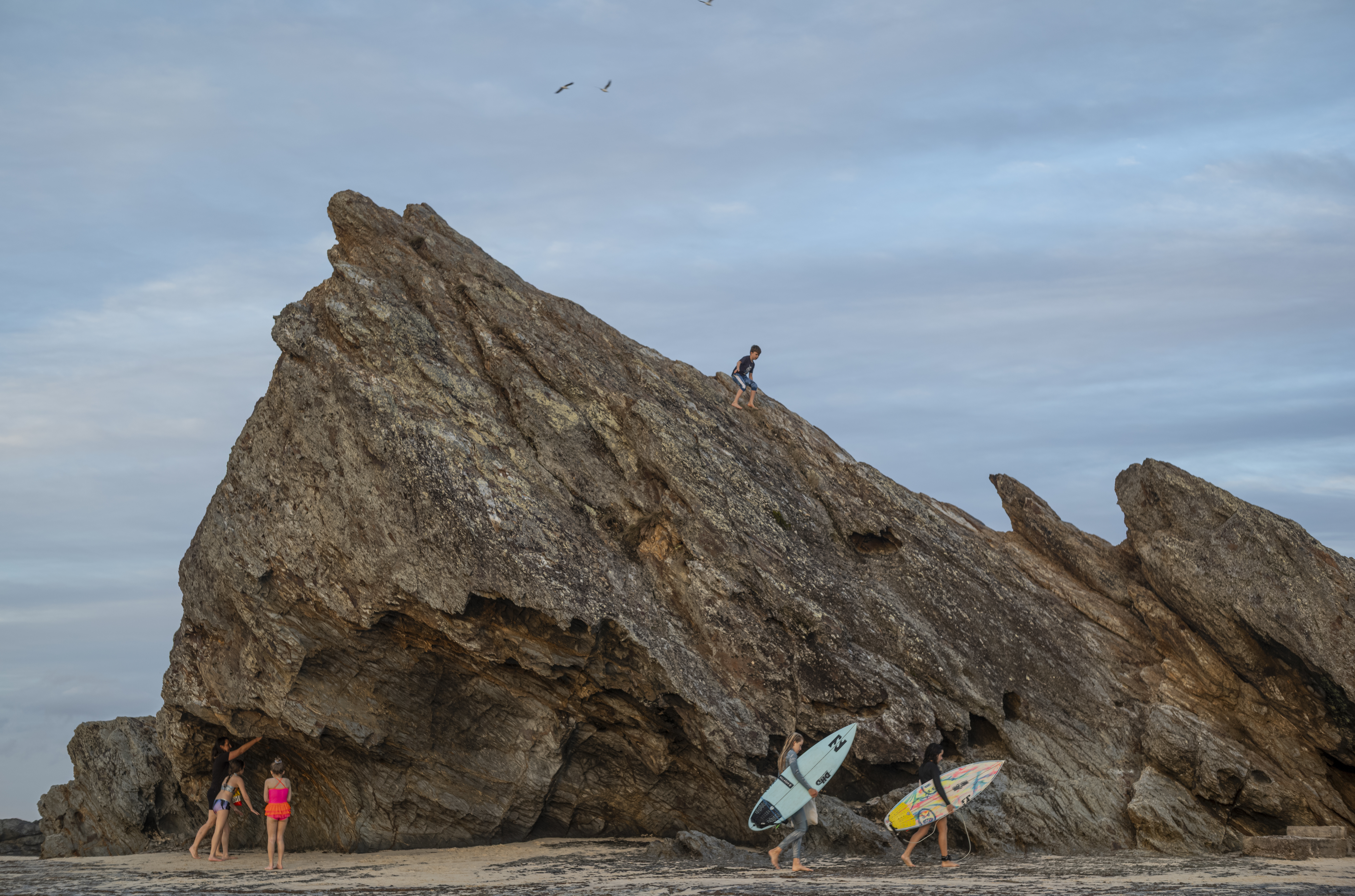
Many of the dramatic geological features of the Gold Coast were shaped by volcanic activity millions of years ago. In the Currumbin area, one of the most famous examples of that activity is Elephant Rock, at the southern end of the beach, overlooking the surf club of the famed Currumbin Vikings. To the north, the equally iconic Currumbin Rock is further evidence of the area’s volcanic activity. Said to be a result of the long-extinct volcanic activity that created Wollumbin/Mt Warning – about 40km to the south-west, in the Tweed Valley – the rock is an easy-to-scramble-over feature that overlooks the Alley.
Despite the increased popularity of the Alley and the surrounding Currumbin seascape, locals like Wade hope the area’s surfing reputation will help ensure it continues to avoid the worst excesses that often come with coastal development.
“For a lot of us who surf, nature is our life. We love nature. If we see rubbish left here and people doing the wrong thing, it upsets us,” Wade says.
For the area’s surfing students, among the lessons invariably drummed into them is to leave the beach in as good or better a condition as when they arrived.
It’s hoped such teachings on sustainability and respect for nature will influence a lifetime of care for the environment from its students – taking the lessons learned at the Alley to the rest of the world.