Trash Free Trails. The name says it all
Established in the UK in 2017, Trash Free Trails (TFT) is all about protecting our trails and the wild places they take us. TFT (re)connects people with nature through the simple act of removing and reducing single use pollution (SUP) – like lollie wrappers, chip packets, drinks cans, plastic bottles and broken glass – from the places where we ride, run and roam.
Since 2019 over 7,000 volunteers have cleaned over 14,000 kms of trail in the UK, donating over 11,000 hours of their time to remove over 550,000 individual items of single use pollution – the value of this work is estimated at over GBP1.5 million (AUD$3 million). Perhaps more importantly the simple act of removing trash from trails makes over 75 per cent of volunteers feel even more connected to nature as they shift from being trail users to trail custodians.
What started as a grassroots cleanup effort in the UK has evolved into a leading voice for environmental conservation in the adventure sports sector across the globe, now including Australia.
In the beginning
TFT was founded by Dom Ferris, a former Marketing Manager for Surfers Against Sewage (SAS) — one of the oldest and most influential environmental action groups born out of an adventure sport community.
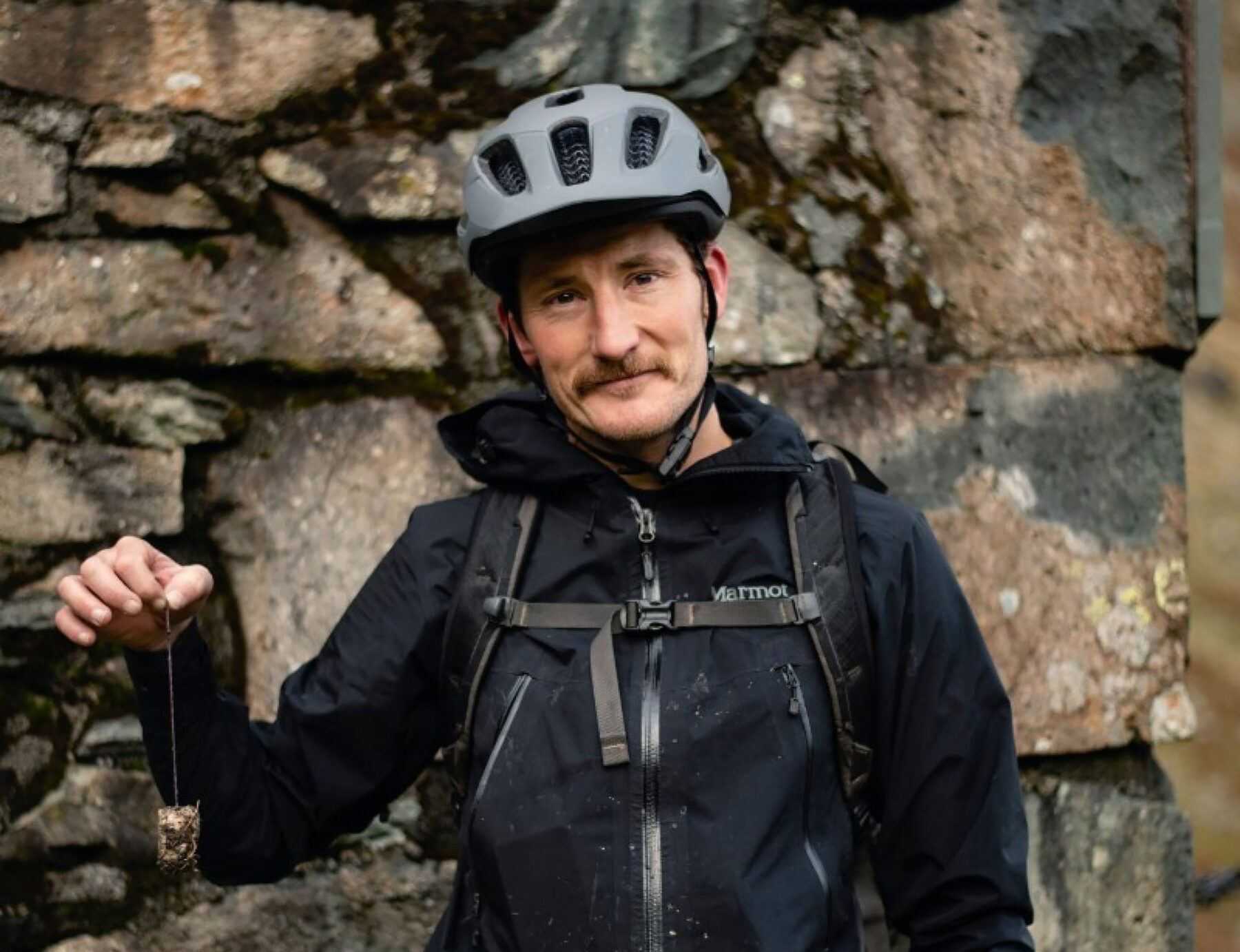
As a mountain biker as well as a surfer, Dom saw many of the issues that blighted Britain’s beaches repeated on the trails, in the woods, and on the hills. The seed was planted in his mind, and he launched Trash Free Trails at the start of 2017.
The founding principle was simple: If you use it, look after it… and if you don’t look after it, you’ll lose it!
The movement was built on the ethos of adventure sports — that those who benefit the most from natural spaces should be the first to defend them. Early efforts focused on organising local “A-Team” clean-ups and mobilising the large, passionate communities of mountain bikers, trail runners and hikers – Riders, Runners and Roamers. TFT effectively leveraged the lifestyle and social aspects of these sports to turn an environmental chore into a fun, community-based activity… by turning any ride, run or roam into a purposeful adventure!
By the end of 2017, TFT had organised its first official trail clean, working with the National Trust in Cornwall. It was an important step – a recognition of legitimacy, and that others had the same desire to make a difference.
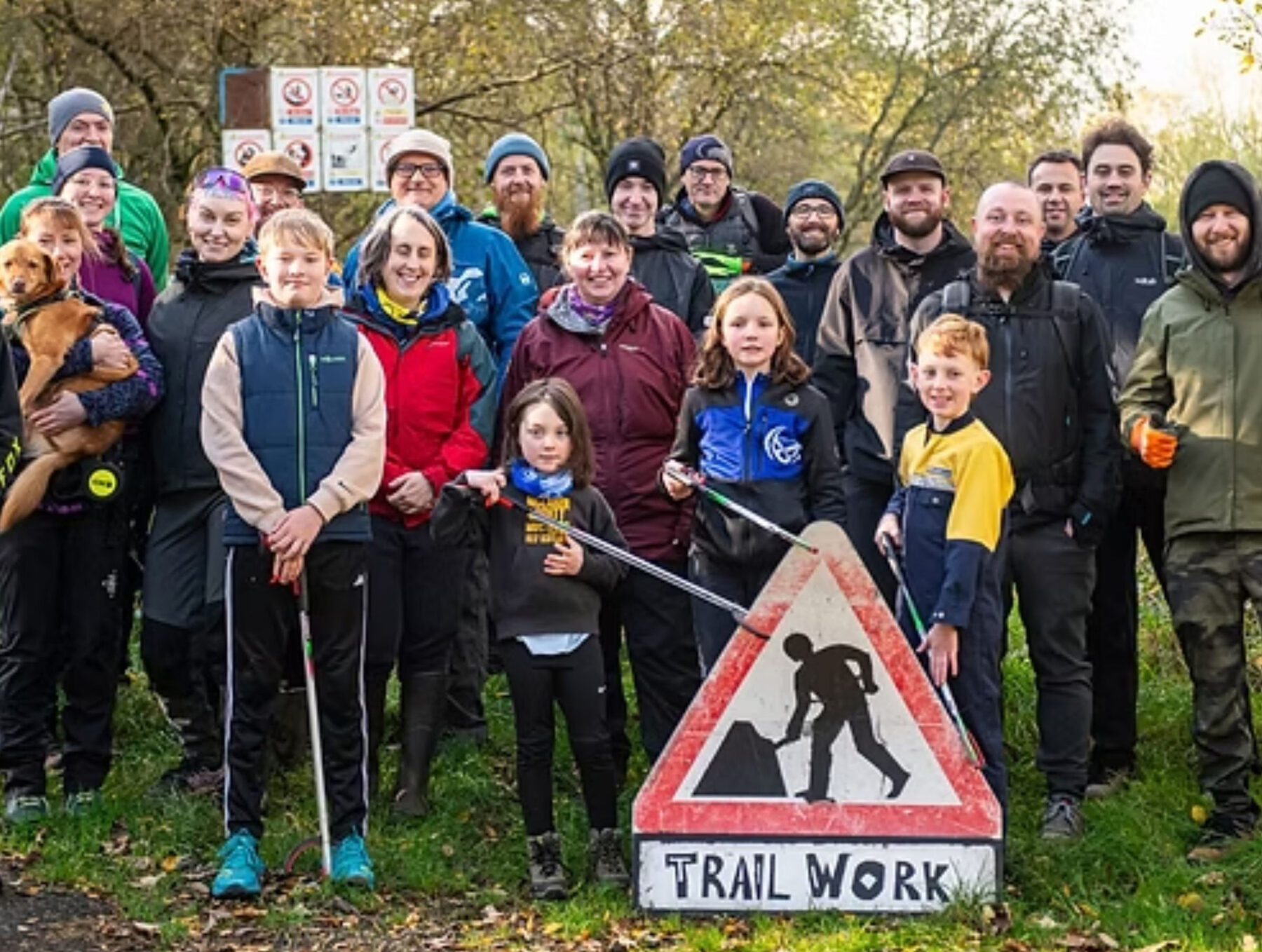
Then, in 2020, the COVID-19 pandemic acted as an unexpected accelerator and inflection point for TFT’s mission. As indoor activities closed and travel restrictions were imposed, millions of people flocked to local trails and green spaces for exercise and mental health. The initial surge in popularity led to a dramatic increase in litter and environmental impact. Then, as people rediscovered their local area – finding themselves on the same trail or in the same outdoor space many times a week and that precious time in nature became a corner of normality. Time to breathe, time to burn off some energy, time for much-needed self-care.
Isolated self-care evolved into collective environmental care – as people would pick up a few pieces of single-use pollution each day, share it on social media, talk to others and enjoy the instant gratification of real-time connection as they watched a piece of nature – their piece of nature – returning to the way it should be. These “trail users” became a digitally connected community of proactive “trail custodians” known in the UK as The Trash Mob.
Community hubs
Today that personal feedback loop has expanded into a vibrant community with thousands of volunteers in over 150 Community Hubs – organisations like clubs, shops, cafes, pubs, schools or even just groups of mates – empowered and equipped to “Do It Ourselves” and do at least four clean-ups on their local trails each year.
Flash trash research
As they remove rubbish, people are encouraged to turn any ride, run, roam or race into valuable data by recording and reporting the rubbish they find and remove using a quick online survey, providing the data and insights required to paint a clearer picture of the source of the problem.
Citizen science
If people want to dial up their contribution to the research they can download the TFT Citizen Science Toolkit – a methodology and set of tools that enables them to provide more detailed and scientific data on the single-use pollution they discover.
State of our trails report
The vast volume of data submitted through Citizen Science forms the foundation of the annual State of Our Trails Report that brings together the findings of thousands of TFT’s volunteers into a one-of-a-kind annual report on the state of single-use pollution on recreational trail ecosystems.
This report provides a benchmark for single-use pollution by tracking contamination levels over time and across different trail types; targets manufacturers with evidence of their products’ environmental impact on terrestrial ecosystems; and influences policy with scientifically sound, irrefutable evidence for systemic changes. There is no other report like this for recreational trails in the world!
In essence, through its Community Hubs and Citizen Science programmes, Trash Free Trails harnesses the collective power of the adventure community to not only take care of trails, but to move beyond annual clean-ups and drive meaningful environmental policy change.
Trash Free Trails Approved
This self-assessment programme allows event organisers to use a checklist to establish whether their event meets specific criteria that then allows them to promote themselves as a “Trash Free Trails Approved” event. Criteria include activities like removing plastic zip ties, how rubbish is sorted and recycled and sweeping the course both before and after an event to measure whether trash has been left behind by participants (and remove it!).
The programme also includes educating event attendees about how they can be reducing environmental impact both at the event and when they return to their local trails.
Trash Free races
In addition, Trash Free Races are mountain biking, trail running and other adventure community events where the Trash Free Trails team is present, providing education and engaging activities to deliver the Trash Free Trails message and bring the philosophy to life, especially for younger trail users. Some notable Trash Free Races include Red Bull Hardline (both in Wales and, in 2025, Tasmania).
Education programmes
TFT has developed a range of education delivery for young people, from a 30-minute session to a multi-day immersion that can be used in schools, clubs and youth groups.
On-trail neural nudging
Recognising that traditional anti-litter signage clearly hasn’t been working, TFT has developed waymarkers that use only positive messaging and emphasise that we don’t just share trails with other people – we share them with the local wildlife.
This simple messaging, combined with the words “Trash Free Trails” provides the neural nudge required to remind people that if they take it in they can take it out – empowering trail users to be aware of the single-use pollution they encounter and take action to remove it.
In the UK, Trash Free Trails is supported and funded through strategic partnerships with brands such as Trek Bikes, Bosch eBike Systems, Orbea, Sprayway, Red Bull and komoot.
How Trash Free Trails found its way to Australia
When he heard about Trash Free Trails on The Ride Companion podcast, Tom Hutton – a mountain biker and trail runner based in Manly on Sydney’s Northern Beaches – loved the simplicity of the mission, saying it worked as a call to action and an outcome and immediately saw how it could extend beyond literal removal of rubbish into areas like trail etiquette and wellbeing.
“Trash Free Trails is the perfect framework to change the way that people connect with their trails, with other trail users and with nature,” he said.
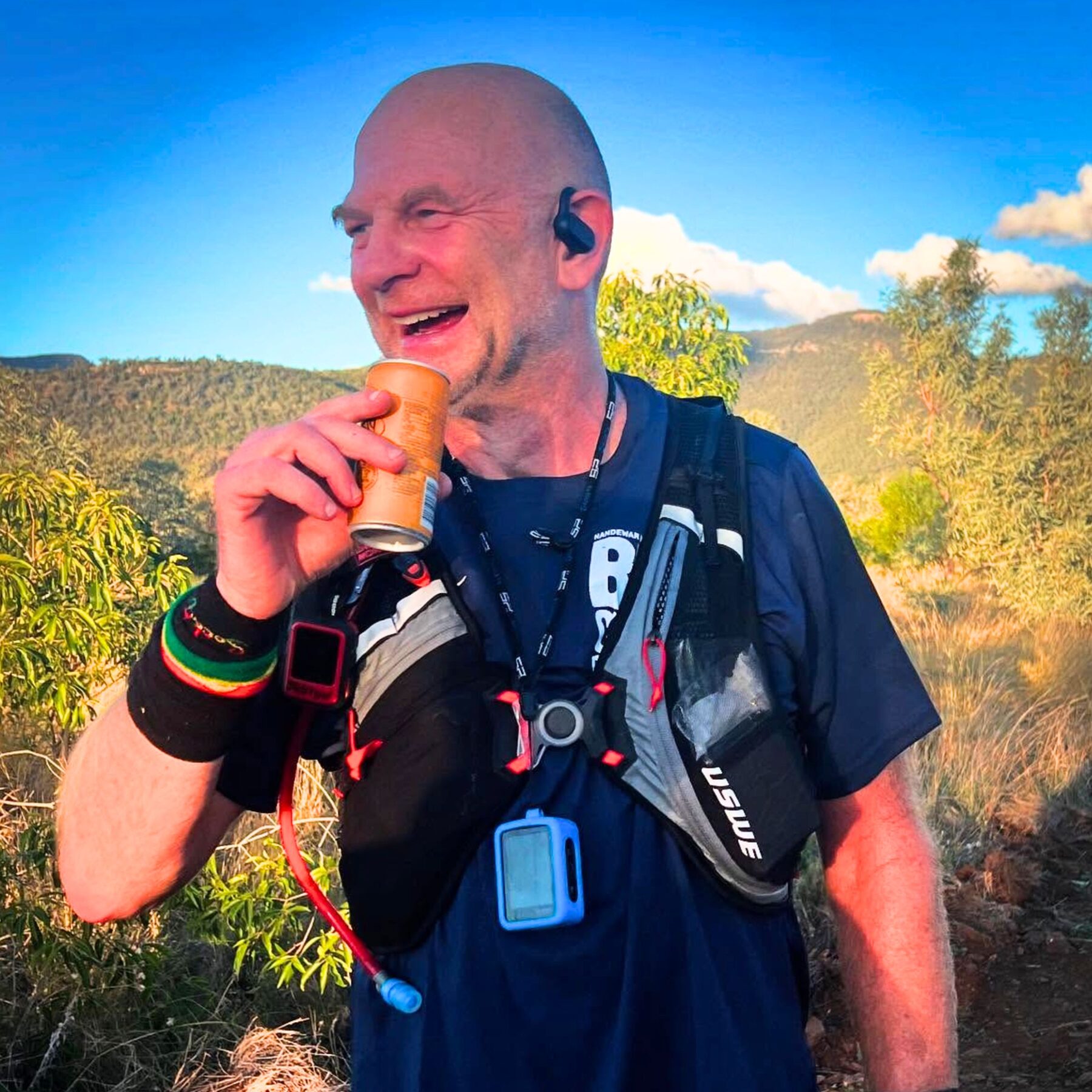

He contacted the team in the UK and asked if he could set up a Community Hub on the biking and walking trail networks around Manly Dam. “Absolutely” came the reply, along with an introduction to Dan Smith, a mountain bike coach and president of Sydney North Offroad Club (SNORC). Like Tom, Dan was looking to establish a Hub on his local trails, including Old Man’s Valley (Hornsby), Jubes (Wahroonga), H2O (Westleigh) and Crackers (St Ives).
Straight away Dan and Tom started to collaborate, introducing the TFT ‘philosophy’ to some of Sydney’s most popular trail networks for riders, runners and roamers.
They started running community hub clean-ups off the back of regular trail maintenance sessions, and have recently started to run stand alone trail clean ups, ranging from ad hoc rides with a few items of trash stashed in a pocket or more formally organised activities, including Trash Free Trail Approved events:
Alpha Trail events
In May 2025 Tom approached Mark Lloyd, race director at Alpha Trail Events, to see if he was interested in making one of his trail running events in Manly Dam a Trash Free Trails Approved event. Mark agreed and not only was the event a successful TFT Approved event, it also saw the first use of Mark’s clip-on-clip-off course flagging system.
A unique ‘speed mark’ course flagging system
This set of reusable trail markers replaces the traditional plastic flagging tape that is usually stuffed in a bin after an event – or left hanging off branches for months or even years. Not only is it more sustainable than traditional flagging tape, the system means that course markings can be set and collected in about half the time. The system has been used by the Garigal Gorillas MTB club to flag three of its Fiver social rides using a custom set in the club’s colours.
Bikes Online team building trash walk
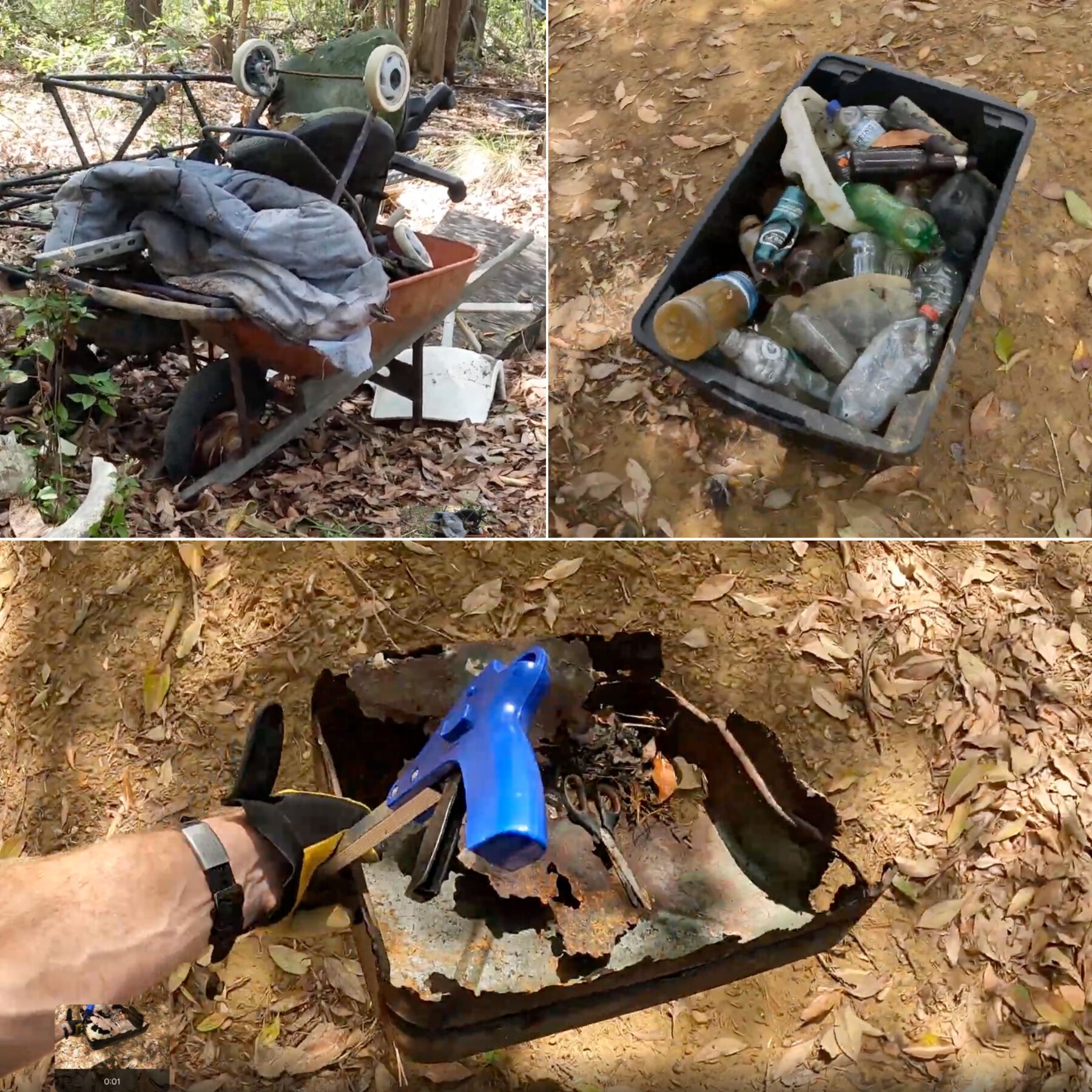
June 2025 saw Tom taking twenty members of staff from Bikes Online – one of Australia’s largest online MTB retailers – on an interactive “Trash Walk and Talk”. This team offsite involved walking through about 5kms of MTB and walking trails in Manly Dam, collecting and recording any trash that they found.
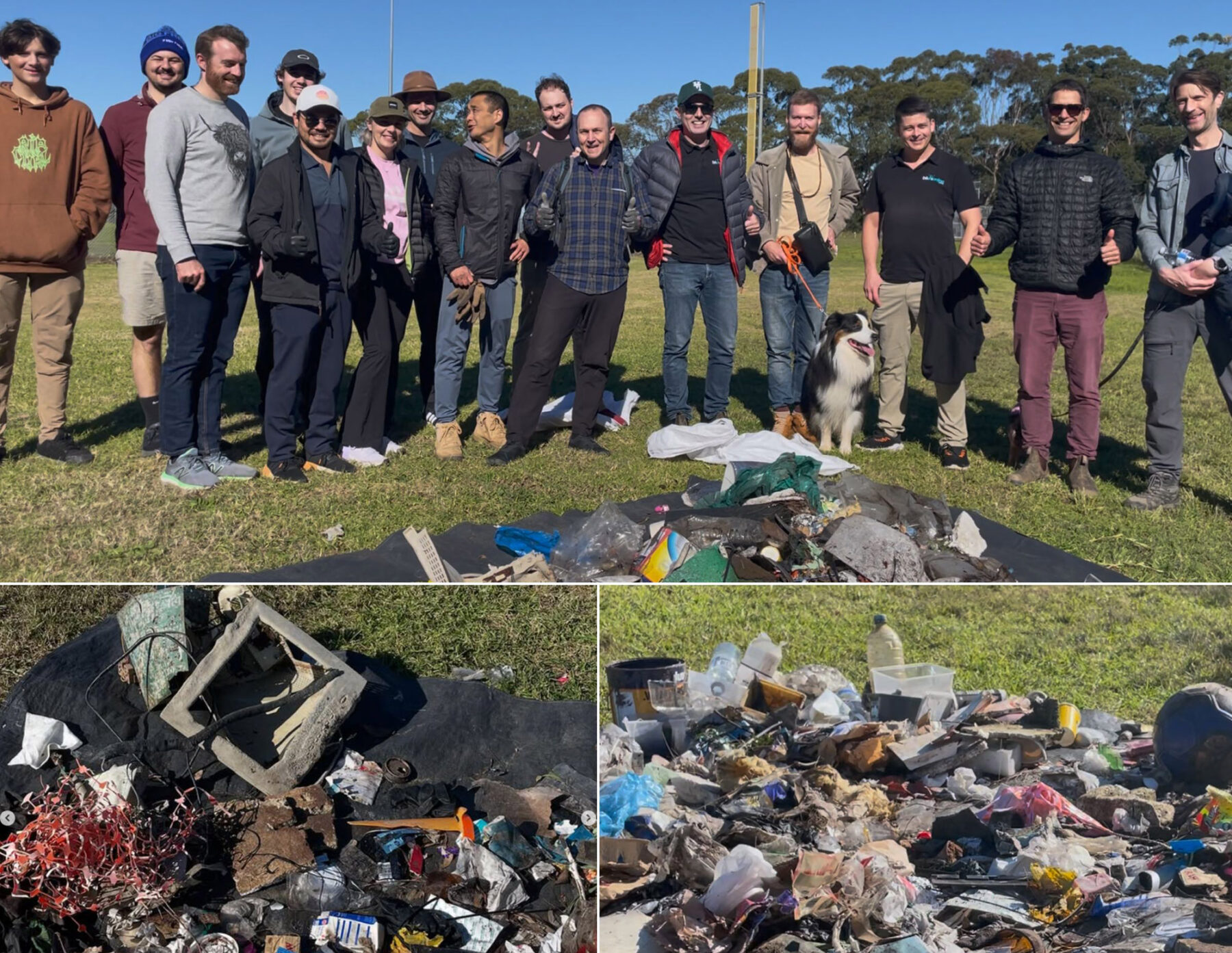
The walk ended with over 25kgs of rubbish ranging from the usual bottles and cans to a computer monitor and a circular saw blade.
“It’s been awesome. We’ve had a good morning out here with the team cleaning up the trails here along Manly Dam. There’s heaps of trash here which I think is a surprise to most of us and just goes to show we’ve got to do more to get this place tidied up and clean so everyone can enjoy it and most importantly the flora and fauna are looked after. It’s been a real eye opener.” said Bikes Online Co-founder, Jonathon Allara.
Berowra Truck Stop
Late in October 2025 Tom and Dan went to a set of abandoned dirt jumps known as Berowra Truck Stop and cleared around 40kgs of trash and cleaned up the jumps, which was the first step required to breathe new life into a site where many kids learn to ride.
Trash for the ’tache
At the end of November 2025 Dan Smith hosted the prototype “Trash for the Tache” ride to raise money and awareness for Movember. WIth 60 men committing suicide every 60 minutes around the world, Dan and some of the SNORC club members rode 60kms around Old Man’s Valley MTB park – twelve laps around an unforgiving technical 5km loop – raising over $1,500. At the same time they collected several kilograms of plastic bottles and empty drink cans.
Supermarket sweep
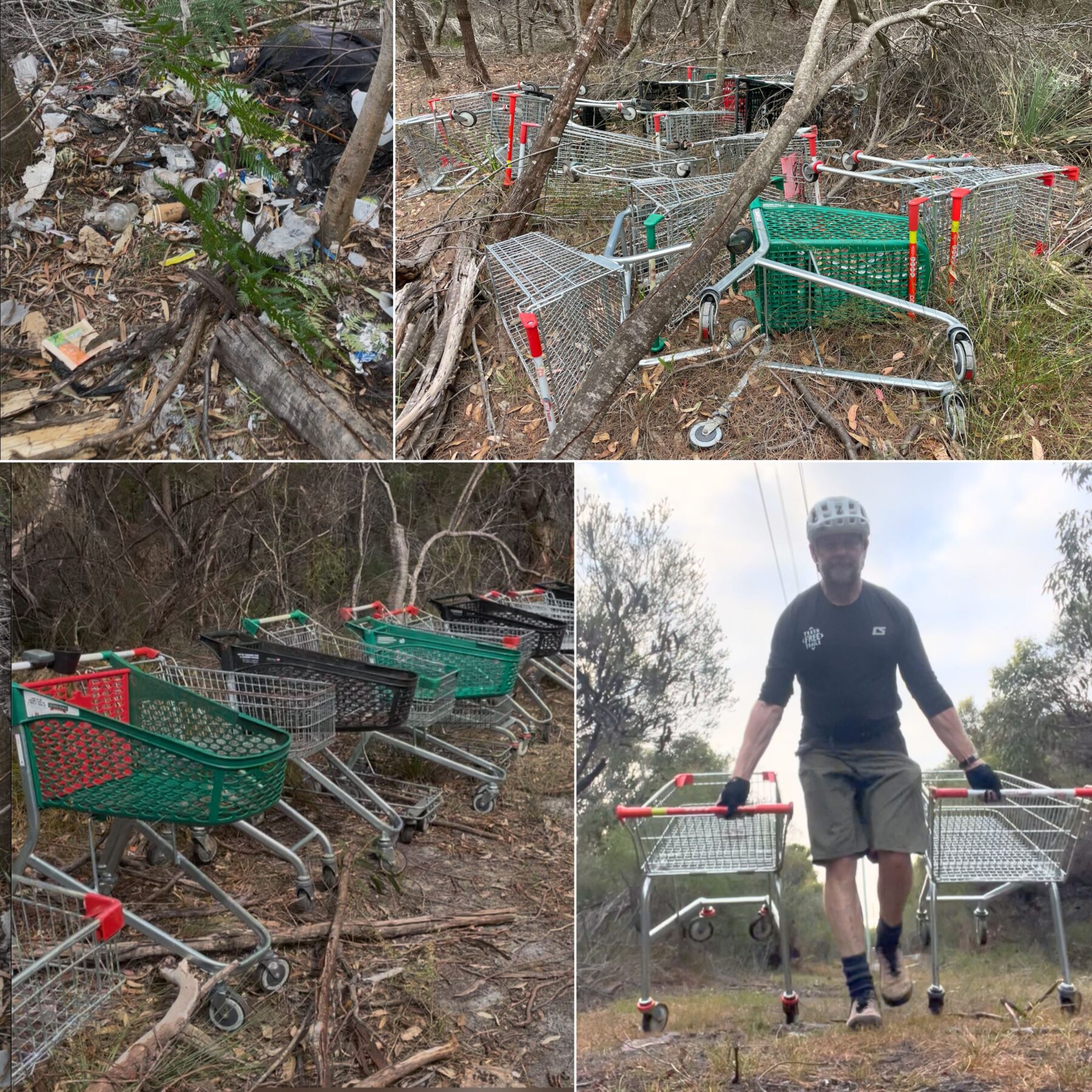
In November 2025 a friend of Tom’s spied the handle of a supermarket trolley just off a popular trail in Manly Dam. Upon further investigation they discovered 27 shopping trolleys that had been dumped in the bush, along with a mound of general rubbish. They pulled all the trolleys out of the bush and dragged them closer to a road for collection by the supermarkets and filled eight rubbish bags before being chased away by some nasty creepy crawlies. The Manly Dam ranger team then finished the clean up. All up around 550kgs of trash was removed in this one activity alone.
Trash Free Gorillas
December 2025 saw the start of a Trash Free Trails trial in The Compound at Mount Narra – home of the Garigal Gorillas, Australia’s largest mountain bike club. A TFT general waste bin has been installed along with an open cage for cans and bottles to make it easy to “sort-at-source” when it comes to recycling. Return-and-earn proceeds are going towards maintenance of the trails that Garigal Gorillas members love to ride. The same trial will be run in Old Man’s Valley bike park.
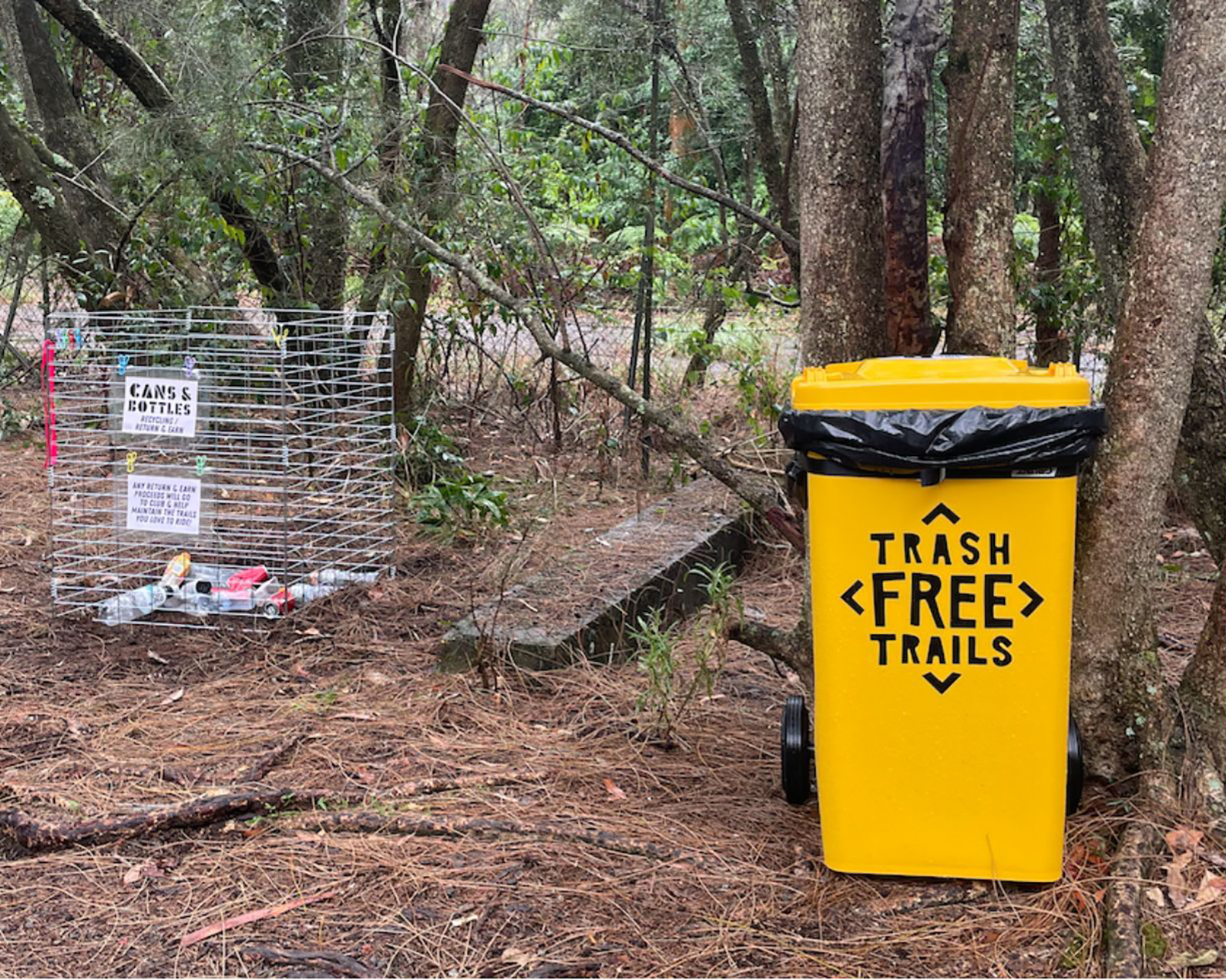
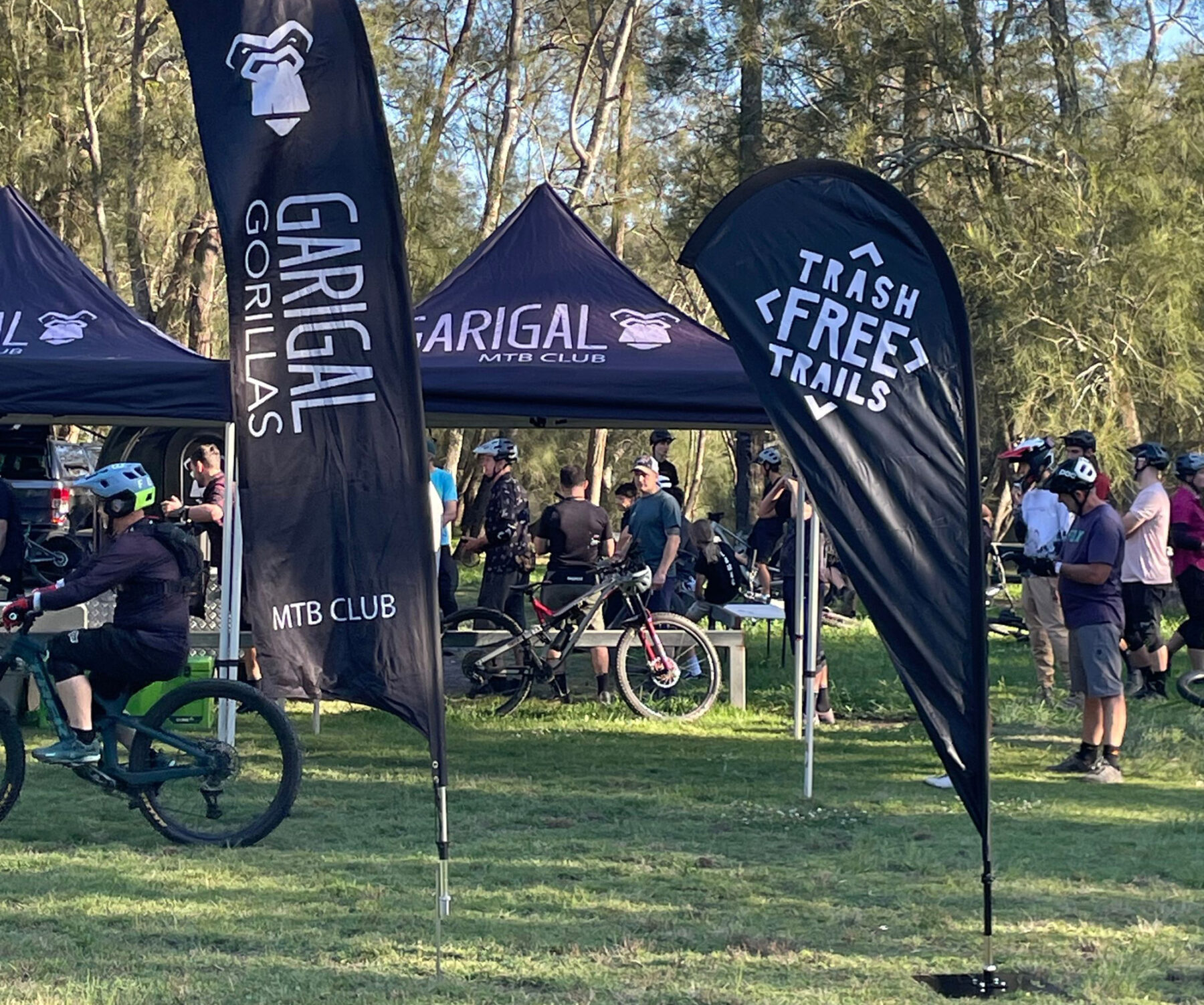
These activities and initiatives have proved that Trash Free Trails has a place in Australian adventure sport, but it was earlier in the year, in September 2025, that it was clear that Trash Free Trails has a place beyond local communities.
Sea Otter Australia
While riding the trails in Mogo, Tom met Martin Wisata – founder of Rocky Trail Group (a leading Australian mountain bike event promoter and destination development company) and COO of Sea Otter Australia. They got talking about Trash Free Trails and soon realised that, as Rocky Trail already had an Ecotourism Australia’s ECO Certification in the Nature Tourism category, it met almost all of the criteria required to be running Trash Free Trails Approved events.
The first Rocky Trail TFT Approved event was the inaugural Sea Otter Australia – the largest cycling festival and industry expo ever held in Australia. This MTB and gravel focused event was held on the NSW coast in Batemans Bay in October 2025 and featured five days of races, demos, an expo, an industry summit and other community events.
There were nearly 9,000 attendees and over 1,800 riders. Dan and Tom were on the ground promoting Trash Free Trails at the expo and on the race course, while a new study by Edinburgh Napier University (Scotland) commissioned by Trash Free Trails was discussed during the summit. (And Dan and Tom did some trail cleaning up Mogo’s epic Burnaaga (Goanna) trail that runs almost 30km from Mount Wanderer to Mogo town.)
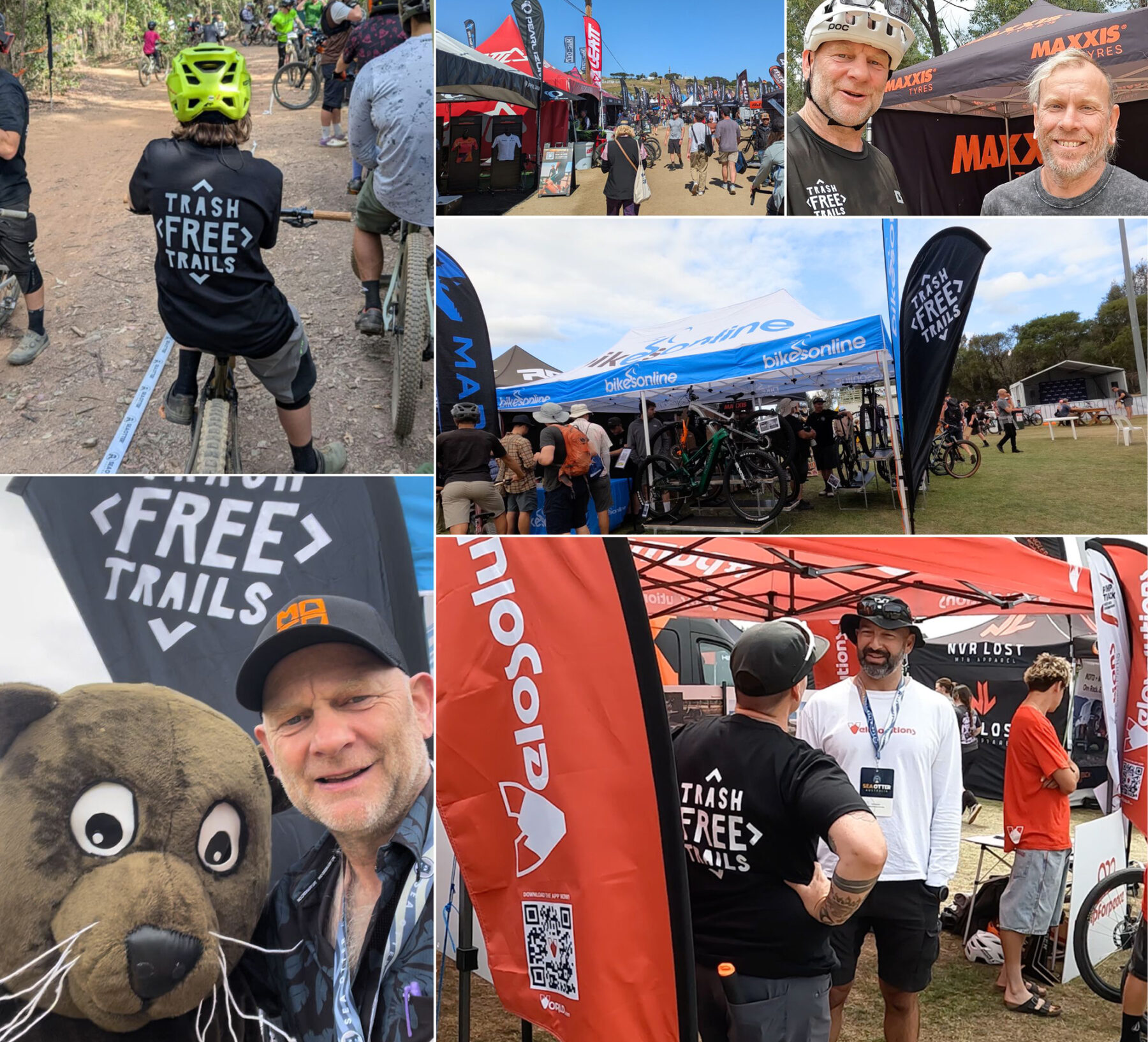
Based on the response from attendees at the Sea Otter Australia summit and expo, plus the response from community groups and local government, it was clear that there was an appetite for Trash Free Trails in Australia, but it would need its own local entity:
“In Australia the way that we access, use and manage our trail networks is very different to the UK. In particular, right now, we are seeing an enormous growth in mountain-biking fuelled by a desire to get outdoors amplified by the accessibility presented by e-MTBs and supported by government funding in trail networks and adventure destination tourism.” Tom Hutton says.
“The exciting thing is that a lot of events and clubs are already doing the right thing, and Trash Free Trails is a really easy way for them to communicate the great work that they are doing. At the same time there are clubs, events, trail networks and destinations that need guidance, and Trash Free Trails provides a really simple framework for them to follow. This in turn helps to gain community support – both with adventure sports like mountain biking and trail running – and across the broader community.
“For me personally, as a mountain biker, trail runner and dog walker, I love that Trash Free Trails can be a uniting force for all trail users. But to maximise the positive impact that we can have, we need to develop some local assets and messaging, and that’s why we have established Trash Free Trails Australia as a local social enterprise – to take the awesome work that Dom and his team have done in the UK and adapt it for adventure sport communities across Australia.”
So, what does the future look like for Trash Free Trails in Australia
In Australia the team’s goal is to adapt what has been done in the UK and to make Trash Free Trails a modular framework that can easily be plugged into any community, club, event, network, bike park, coaching business, school, retailer, manufacturer or any other trail-related activity and deliver one or more of these overarching outcomes:
Healthier trails
- Trail ecosystems are protected and restored.
- Single Use Pollution (SUP) – like drink cans, food containers, gel sachets and lolly wrappers – is reduced and potential threat to flora and fauna reduced.
- Robust trail-based SUP monitoring informs planning, policy and action.
Happier trail users
- Deeper and more meaningful (re)connection with self, with others and with nature.
- Greater appreciation for outdoor adventures and shifting from ‘trail users’ to ‘trail custodians’, empowered by the Do It Ourselves and Citizen Science frameworks.
- Improved well-being amplified by a sense of giving back, doing good and being part of a community with purpose.
Harmonious communities
- Active and equipped communities caring for local trails and for each other.
- Collaborative partnerships and practices that help to shift attitude, behaviour, culture, relationships and policy.
- Accessible activations lead to broader and more diverse participation.
The plan is to proactively recruit more groups and smaller organisations to become Community Hubs, managed by the team in the UK. Where necessary the TFTAU will facilitate onboarding and provide the local assets required to maximise local impact.
“We like creating easy to remember and easy to action messages, so we have created a local version of the “Trash Free” philosophy to help deliver these outcomes,” Tom says. “Here goes:
- Tread and Shred Lightly: Leave a positive trace, remove rubbish (e.g. food wrappers and drink containers), report what you can’t safely move.
- Respect: Honour the traditions and cultural heritage of the Traditional Custodians of this land.
- Act Responsibly: Stay safe, protect flora and fauna and do not damage the trails.
- Share the Trails: Look out for other trail users, communicate, give way and smile.
- Help out: Do whatever you can – record findings, report hazards, offer aid, do maintenance, show your thanks, spread the word.
- Flow: Have fun and enjoy being in nature.
- Recharge: Use this precious time to refresh or reset your body and mind.
- Explore: Discover and share new places and experiences.
- Engage: Share the philosophy with others, educate and inspire action.
“Simply by adopting this philosophy people will be helping to improve the state of our trails down under. That said, we plan to do much more!” Tom says.
Just the beginning
The team is localising the original TFT surveys and toolkits so that they have a local flavour, still feeding invaluable data into the international research and future global State Of Our Trails reports.
TFTAU is planning to build on the relationship with Rocky Trail Entertainment and Sea Otter Australia, with the goal of creating more gold standard Trash Free Trails Approved events in Australia. They will also be expanding the TFT Approved programme beyond events into areas like coaching, retail, manufacturing and media.
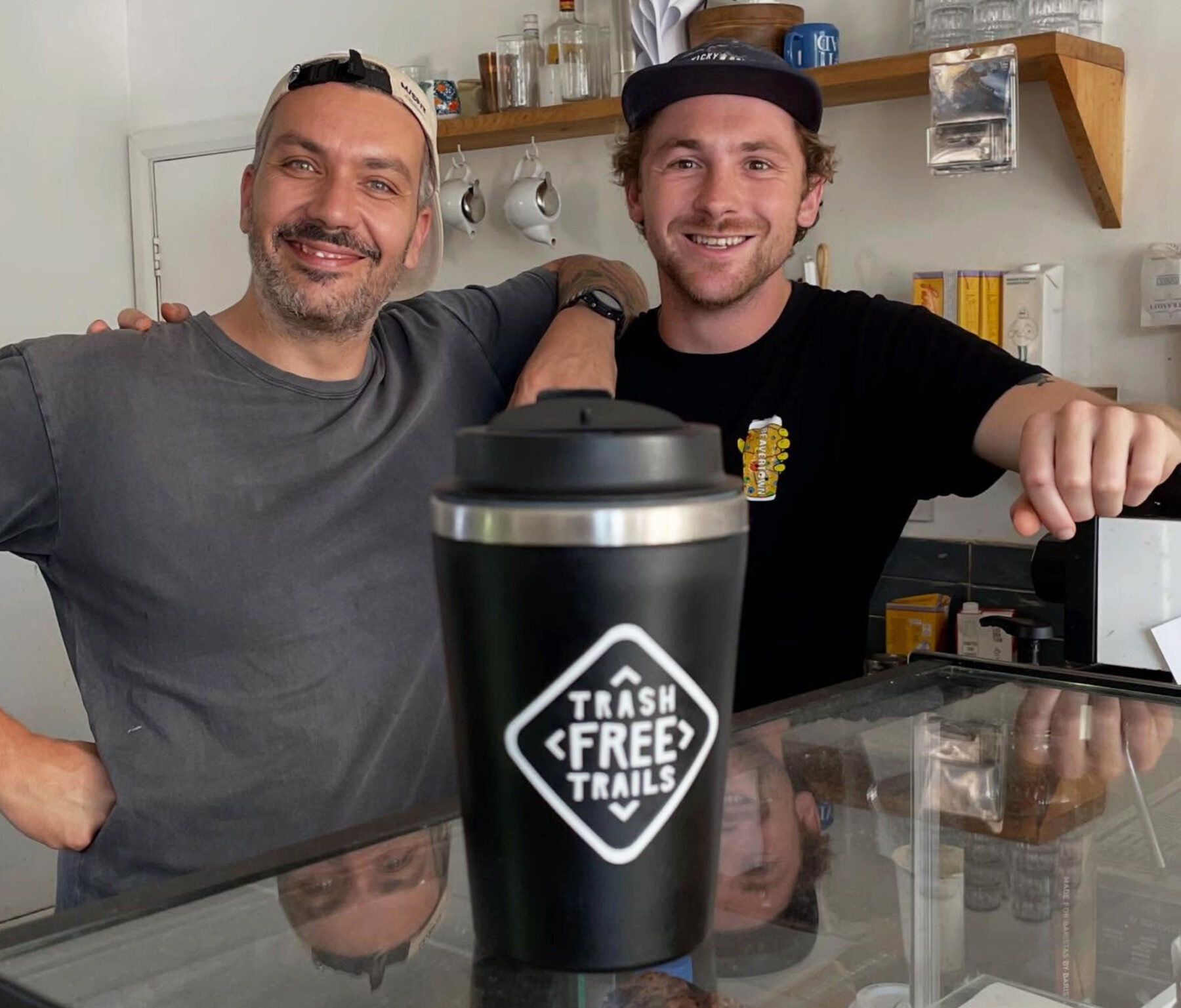
Branded products are being developed that serve a functional purpose while simultaneously delivering a message that helps to create (or reinforce) positive behavioural change when it comes to reducing trash on our trails. For example TFTAU keep cups reduce the number of single use coffee cups and lids that may find their way into wild places. The TFTAU stubby cooler helps to keep your can or bottle cool, but also reminds you to dispose of your empties responsibly. These products will help to raise the funds required to run TFTAU.
To summarise, TFT founder Dom Ferris says, “From the outset, when I founded Trash Free Trails I always intended for it to go international, so trail users across the world could come together to protect the places they love. What’s exciting about the work that Tom and Dan are doing in Australia is that they are adapting and optimising the Trash Free Trails framework for the specific needs of the Australian environment, and that is then coming back to us in the UK, giving us a different perspective that we can learn from and share.”
Get involved
Go to Trash Free Trails Australia to read more about this awesome initiative, to get involved, and to sign up for updates. Trash Free Trails Australia is a collaboration.